The Mammoth Book of Classic Science Fiction Short Novels of the 1930's
This pioneering anthology collects classic 1930s science fiction novellas that laid the foundations of the Golden Age, celebrating fearless human imagination and deep cosmic wonder.
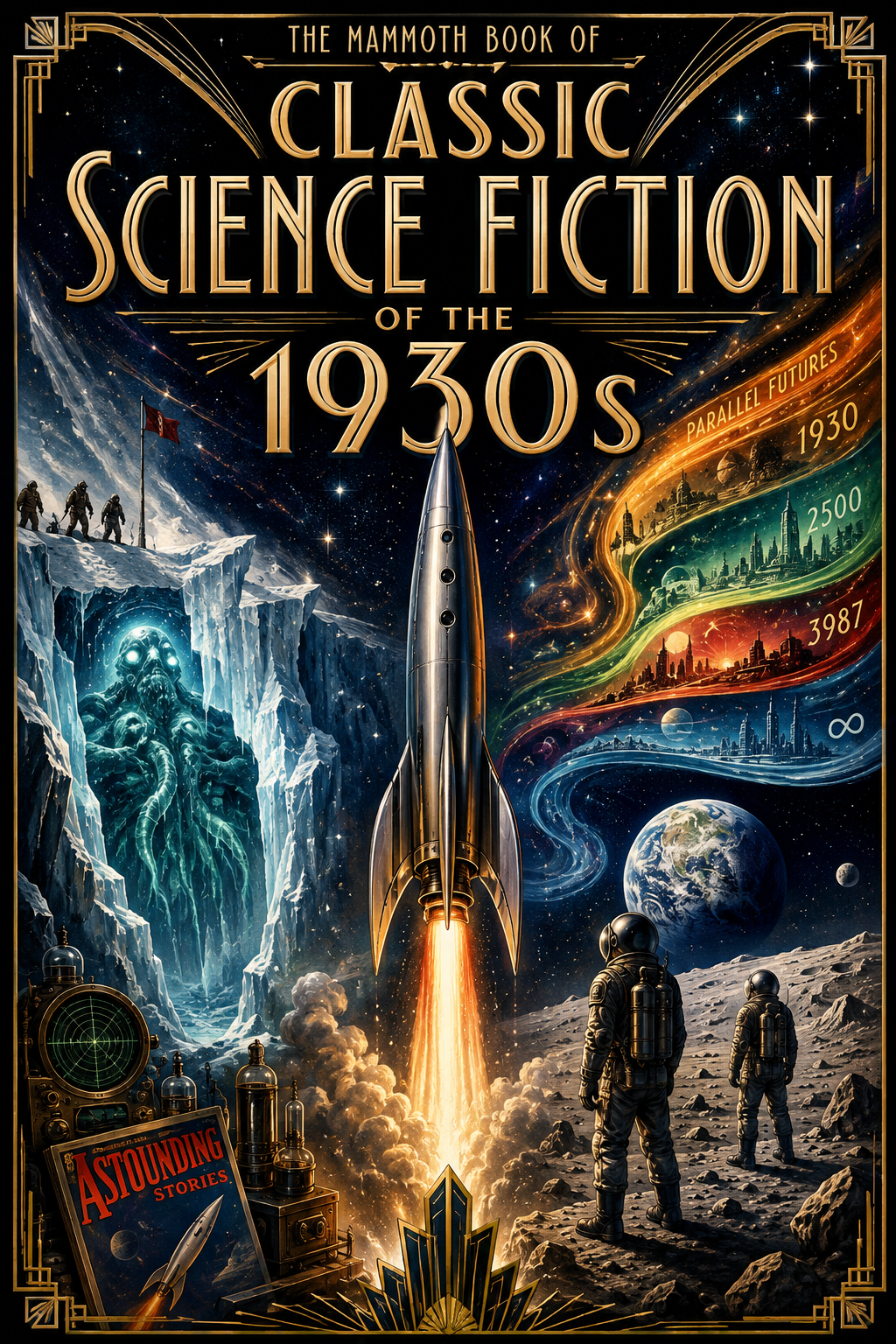
Imagine stepping into a time machine and setting the dial for the 1930s, a decade when the world stood on the edge of a great transformation. Rockets had not yet reached space, computers were nothing but wild dreams, and the secrets of atomic energy remained mysterious. Yet, within the pages of early imaginative magazines like Astounding Stories, Wonder Stories, and Amazing Stories, a quiet revolution was taking place. Writers were busy building laboratories of the mind, laying the foundations for what would soon become the Golden Age of Science Fiction. Opening the pages of this grand collection, curated with the thoughtful guidance of editors like Isaac Asimov, is not merely opening a book of old tales. It represents a narrative journey through an expanding universe of speculative thought, showing how human curiosity can look beyond the limits of its own time to dream on a truly cosmic scale.
The voyage begins in the deep reaches of space within the vast interplanetary civilization of Jack Williamson’s The Legion of Space. Here, humanity has successfully claimed the Solar System, living under the protective watch of a legendary military order. But peace is a fragile thing, preserved only by a closely guarded secret weapon capable of destroying entire civilizations. When a young man named John Star is pulled into a dangerous conspiracy involving kidnapping, political intrigue, and space battles, the story sweeps into a grand adventure. Yet, as the story builds, the true conflict is revealed not to be in the lasers or space battles, but in a quiet, logical question of ethics. Williamson is not just writing an exciting adventure; he is asking whether human beings have the moral maturity to handle a power so absolute.
Leaving the starships behind, the narrative travels thousands of years into the future to a silent, altered Earth in Stanley G. Weinbaum’s The Black Flame. Civilization has collapsed and slowly rebuilt itself into isolated, scattered societies. Legends whisper of the Black Flame, an immortal woman who possesses ancient, godlike scientific knowledge and breathtaking beauty. The plot follows a lonely explorer who journeys across dangerous deserts and forgotten kingdoms to find out if she truly exists. When they finally meet, the narrative shifts from an exciting quest into a deep, philosophical exploration of the human heart. Weinbaum shows that immortality, once thought to be a great human goal, is actually a heavy burden of loneliness and memory that separates a person from the flow of ordinary life, questioning what it really means to be civilized.
Suddenly, the warm sands of the future turn into the biting, frozen winds of Antarctica in John W. Campbell’s classic masterpiece, Who Goes There?. A group of isolated scientists uncovers a strange extraterrestrial creature that has been frozen in the deep ice for thousands of years. But when the creature wakes, they discover a nightmare of absolute paranoia: the alien does not fight with teeth and claws, but by perfectly imitating any living thing it absorbs. Every man in the station becomes a suspect, and every conversation is thick with the fear of betrayal. The tension builds to an unbearable peak, yet the story leads toward a powerful, logical resolution. Campbell shows that panic is useless; instead, the scientists must rely on systematic, careful experimentation and scientific reasoning to expose the threat, proving that human intelligence is the strongest shield against the unknown.
Campbell then takes the setting from the frozen Earth to the silent, airless plains of the Moon in The Moon Is Hell!. The story follows a scientific expedition that becomes completely stranded when a disaster destroys their only way home. The Moon is a cold, unforgiving desert where air, water, and power are finite resources that are quickly running out. Instead of saving the crew with miraculous inventions or heroic sacrifices, the story builds tension through the quiet details of daily survival. The scientists use engineering, careful planning, and chemical improvisation to solve every practical problem. It is a beautiful celebration of the human mind, showing that reason and cooperation can turn even the most hopeless environment into a place where humanity can survive.
A traveler of a different kind appears in P. Schuyler Miller’s The Forgotten Man of Space. This explorer returns to Earth after traveling across unimaginable, distant stellar systems. Though he has gathered immense cosmic knowledge, his long journey has psychologically separated him from the rest of humanity. People look at him with a mix of curiosity, admiration, and deep suspicion, unable to comprehend what he has seen. Through this poignant tale, the narrative builds a quiet warning: scientific exploration does not just change what is discovered in the stars; it changes what humans become, sometimes creating an intellectual distance so vast that the explorer can never truly return home.
The narrative journey returns to Weinbaum’s cyclical future in Dawn of Flame. In this era, small communities are struggling to preserve the broken fragments of scientific knowledge that survived a great catastrophe. Explorers stumble upon ancient laboratories and machines, viewing them with a sense of wonder that borders on magic. The story does not dwell on the despair of collapse; instead, it builds a powerful message of hope. It shows that even when great structures fall, the burning spark of human curiosity and the drive to understand will always guide humanity back toward renewal.
This same scientific ambition turns inward in Weinbaum’s The Adaptive Ultimate. Here, scientists develop an experimental treatment that allows the human body to instantly adapt to any physical danger or disease. At first, the results are a miraculous triumph of biology. But as the story progresses, the adaptation spreads from the physical body into the patient's mind and morals. Survival becomes the only instinct, completely erasing compassion and empathy. Weinbaum builds a logical, chilling lesson about the limits of scientific ambition, reminding readers that every technological breakthrough carries a heavy weight of moral responsibility that science alone cannot resolve.
Finally, the ultimate mystery unfolds in John Taine’s The Time Stream. Scientists find a way to observe different streams of time, discovering that history is not a single, unchangeable line, but a complex web of multiple futures. Soon, causes and effects begin to tangle, and characters experience the consequences of actions before they have even taken them. The narrative leads to a fascinating philosophical puzzle, asking whether human destiny can truly be changed if the future can already be seen, or if humanity consists simply of actors following a prewritten script.
As the journey through these classic novellas ends, a look back reveals how these authors transformed a young genre. Writing under tight deadlines and with limited resources, they nevertheless possessed a fearless imagination. They expanded science fiction from simple, wild adventures into a profound study of psychology, engineering, biology, sociology, and cosmology. Under Asimov’s editorial eye, this collection becomes a testament to scientific optimism, showing that no matter how dark the universe may seem, human intelligence, cooperation, and curiosity will always offer a way forward. These stories did not just predict the future; they taught readers how to dream on a cosmic scale, shaping the themes of Asimov and countless other legendary writers who followed.