Monsters
This 1988 science fiction anthology collects eleven stories showing that true monsters are often born from human fear, prejudice, and misunderstanding rather than alien biology.
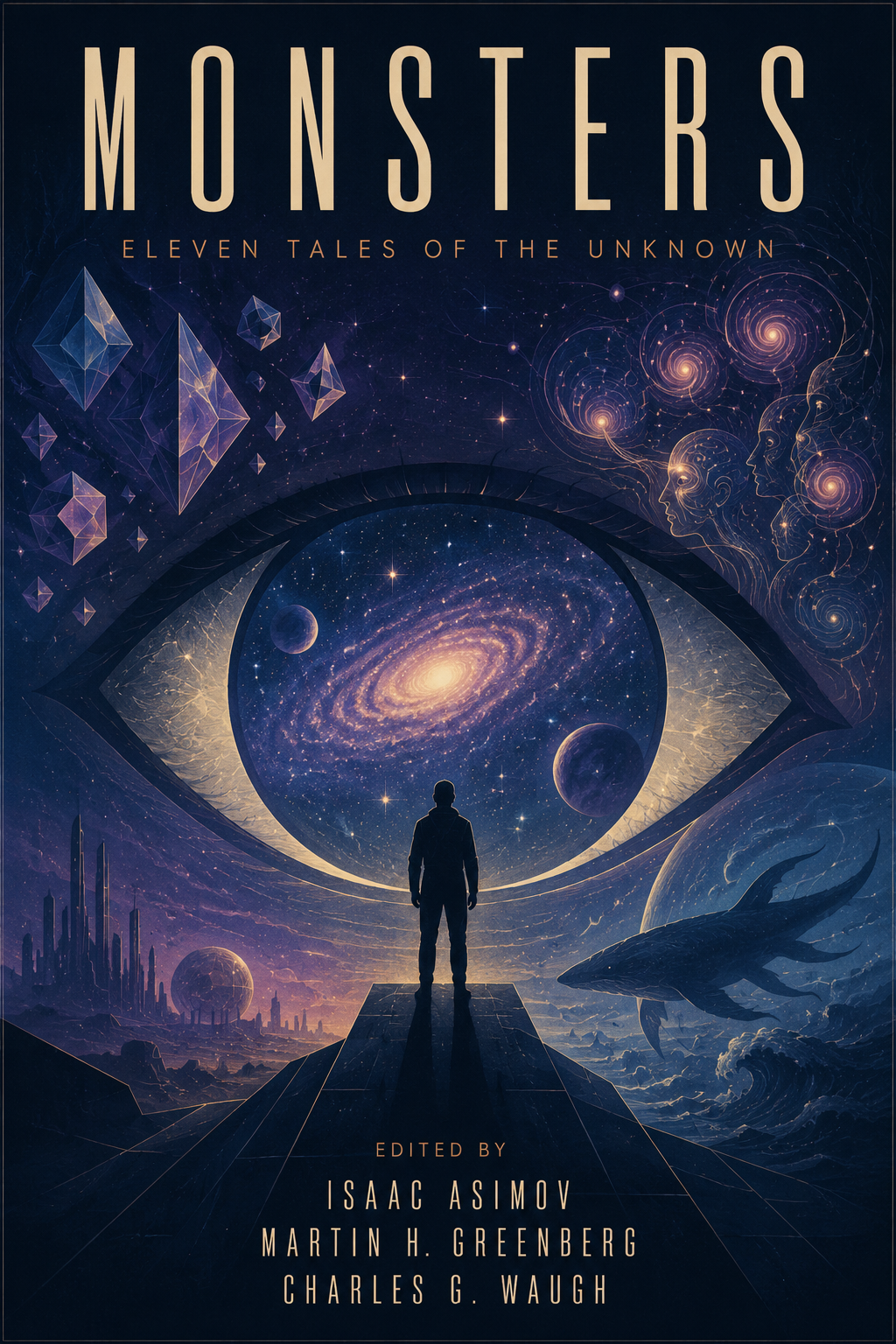
It is a quiet evening when one opens a book and expects to find the traditional horrors of claws, fangs, and scales, only to discover that the universe is far more complex and subtle than our childhood nightmares suggested. In 1988, Isaac Asimov, alongside Martin H. Greenberg and Charles G. Waugh, presented a thematic science fiction anthology simply titled Monsters. This collection of eleven classic stories does not merely seek to frighten the reader; instead, it serves as a logical and clear eyed exploration of the unknown. For those familiar with Asimov’s own extensive bibliography, from the rationalist puzzle solving of his Robot stories to the sweeping historical sociology of the Foundation series, the editorial philosophy behind this book feels immediately familiar. Throughout his career, Asimov worked tirelessly to dismantle what he termed the "Frankenstein complex", the irrational, deep seated fear that the creations of science and the unknown corners of the universe must inevitably turn on humanity to destroy us. This anthology represents a direct extension of that lifelong intellectual campaign, building from the raw, fearful pulp traditions of early science fiction and leading toward a mature, empathetic, and highly logical literature of change.
Asimov begins the collection with an introduction that gently challenges our historical biases, pointing out that fairy tales and traditional horror have conditioned humanity to fear the physically grotesque. Science fiction, however, expands this narrow definition by showing us that true fear often arises not from malice, but from absolute difference, and that sometimes the real monster in the room is our own fear, ignorance, or arrogance. Rather than viewing monsters as external evils to be conquered by brute force, Asimov invites us to approach them as scientific and psychological phenomena to be understood. The collection acts as a grand narrative journey, with each story functioning as a chapter in our species' psychological evolution.
The journey begins in the shadows of our own minds with Robert Silverberg’s narrative, which introduces us to the invisible alien parasites known as the Passengers. In this quiet invasion, humans find themselves temporarily possessed by forces they can neither see, touch, nor resist. Society continues to function in a state of perpetual tension, where families break apart and relationships crumble because no one can be certain if a loved one’s actions are truly their own. The protagonist moves through this psychological minefield, navigating a world where the theft of free will is far more terrifying than physical violence. Silverberg’s story sets the tone for the anthology by showing a monster without a face, illustrating how helplessness can be built slowly and quietly through the simple loss of personal autonomy, forcing us to ask whether human identity can survive when the mind itself is hijacked.
From the psychological void, the collection transitions into the world of classical art and historical mystery in Lloyd Biggle Jr.’s work, which explores a strange anomaly hidden within a priceless Renaissance painting. When art historians and scientists notice an impossible creature that appears to possess a bizarre, lifelike quality within the masterpiece, their attempts to analyze it only deepen the mystery. Rather than delivering a conventional monster that strikes from the dark, the story examines what happens when ancient, alien elements cross into the modern world through the medium of human beauty. The narrative suggests that there are mysteries of existence that cannot be neatly solved by scientific tools alone, reminding us of the thin line that separates high art from existential dread and showing that the unknown can wear the face of sublime creation.
The exploration of the unfamiliar continues with J. H. Rosny aîné, who takes us back to the early days of science fiction to witness a profound encounter between human explorers and entities of entirely different forms. Because these beings exist and perceive reality in a manner completely alien to human experience, communication between the two species is rendered nearly impossible. The tension that develops in this meeting does not stem from active hostility, but from the mutual incomprehension that separates them. The narrative illustrates how humanity instinctively labels the unfamiliar as monstrous simply because it does not fit into our pre existing categories, beautifully capturing a sense of cosmic wonder alongside the natural fear of the unknown, and reminding us that first contact is as much a test of our minds as it is of our technology.
The focus then shifts from distant worlds to the ethical boundaries of our own laboratories in Theodore L. Thomas’s examination of biological creation. When scientific advancements allow for the successful cloning of living beings, society is forced to confront difficult questions regarding identity, dignity, and individual freedom. As the identical creations begin to multiply, suspicion and deep seated prejudice rapidly infect the general population. Just as Asimov's robot stories examined how humans react with panic to the mechanical "other," the true horror of this biological scenario is not found in the clones themselves, but rather in the hostile, panicked reaction of the human society around them. It is a narrative that transforms scientific progress into a mirror of moral uncertainty, showing that fear often grows much faster than actual knowledge.
Humanity’s capacity for misunderstanding is satirized in William Tenn’s story, which turns our attention to the small spaces of our own homes. When humans discover that an intelligent, miniature civilization is living quietly inside the very walls of their buildings, the interactions between the two species quickly deteriorate into mutual dread. Because of the vast difference in scale, each side perceives the other as an enormous, terrifying, and destructive threat. Tenn uses this clever premise to craft a satire about cultural prejudice, demonstrating that when two societies refuse to understand one another, they both end up acting like monsters. In this case, the monster is not a physical threat, but the simple, destructive force of human intolerance and the absurd limits of our self centered perspectives.
The collection then takes the reader on a thrilling, high stakes adventure across the dangerous oceans of Venus in Roger Zelazny’s contribution. Professional hunters embark on an expedition to capture a legendary, colossal sea creature of mythical proportions. The narrative is filled with vivid descriptions of advanced marine technology, turbulent waves, and the relentless drive of human ambition. Yet, as the hunt intensifies, it becomes clear that the magnificent beast is merely a natural animal defending its life and territory. In a brilliant thematic shift, the story demonstrates that the hunters’ obsessive desire to conquer and dominate nature is far more terrifying than the wild creature they pursue, illustrating that our own imperial ambitions can be the most destructive force in the galaxy.
A different kind of ecological threat is examined in Floyd L. Wallace’s account of an alien organism that is accidentally transported to Earth. Although the tiny creature initially seems harmless, its extraordinary capacity to adapt and reproduce causes it to quickly overwhelm its new environment. The suspense of this story does not come from physical combat or alien malice, but from the cold, unstoppable mathematics of biology. Wallace demonstrates how an otherwise normal life form can become catastrophic when it is introduced into an ecosystem that has no natural defenses against it. The organism is not evil; it is simply doing what it was designed to do, yet the consequences for humanity are devastating, highlighting the unintended consequences of our expanding cosmic reach.
The anthology also pays tribute to the foundations of modern science fiction with A. E. van Vogt’s classic tale of a space exploration vessel landing on an ancient, desolate world. Here, the crew encounters Coeurl, a highly intelligent, black predator that possesses incredible speed, physical cunning, and psychic abilities. Instead of attacking blindly like a common beast, Coeurl quietly and patiently studies the humans, learning their weaknesses while hiding its own formidable capabilities. The resulting conflict is not a test of brute strength, but a high stakes chess match of intellect and survival, representing the classic pulp era's focus on the deadly dangers lurking in deep space. This landmark story created a prototype for many of the famous extraterrestrial predators that would later populate modern cinema, representing the historical starting point from which the anthology’s more psychological stories eventually evolved.
The psychological complexity of relationships is explored in Philip José Farmer’s highly unusual story of human explorers who encounter a colossal, maternal alien organism. The creature’s overwhelming protective instincts dominate its interactions with the humans, nurturing and shielding them in a manner that feels deeply suffocating. Farmer blurs the boundary between love and captivity, forcing the characters and the reader to ask whether extreme, unconditional care can eventually become a form of absolute domination. The terror in this story comes not from hatred, but from an alien affection that is expressed through a psychology we cannot comprehend, showing how even the most positive human concepts can become monstrous when stripped of mutual understanding.
The theme of survival is taken to a harsh colony world in Murray Leinster’s award winning narrative. In an environment where massive, deadly predators roam freely and communications with the rest of civilization have completely collapsed, human settlers must rely on their intelligence, discipline, and unique animal companions to stay alive. Rather than attempting to exterminate the native wildlife, the characters succeed by learning how to adapt and coexist within the planet's existing ecosystem. Leinster’s story celebrates human courage and cooperation, proving that monsters are simply natural parts of their own worlds, and that survival is a matter of understanding and adaptation rather than mindless destruction.
Finally, Michael Shaara brings the anthology to a reflective, quiet close by depicting humanity’s long awaited return from the stars. The explorers return home expecting a grand celebration, only to find that time and society have progressed in ways that make their own home completely unrecognizable. Instead of encountering external threats in deep space, they find themselves utterly alienated within their own civilization. The story ends on a poignant note, suggesting that the passage of time, the loneliness of long journeys, and the rapid pace of human progress can turn our most familiar spaces into the most alienating monsters of all, bringing our cosmic search for monsters full circle back to the mirror of our own changing identity.
In the end, Isaac Asimov, Martin H. Greenberg, and Charles G. Waugh succeeded in curating a collection that does not merely entertain, but deeply educates. By choosing stories where the monsters are parasites, scientific errors, misunderstood creatures, or our own reflections, the editors created a powerful mosaic of the human condition. The enduring success of this 1988 anthology lies in its refusal to offer simple, black and white villains. It leaves the reader with the lasting, quiet realization that the universe is not inherently hostile, merely vast, and that the most dangerous monsters are often those born not from alien worlds, but from the limits of human understanding.