Young Witches and Warlocks
Asimov’s anthology features ten stories where magical youth navigate growth and responsibility, using imagination as a lens for understanding reality and human empathy.
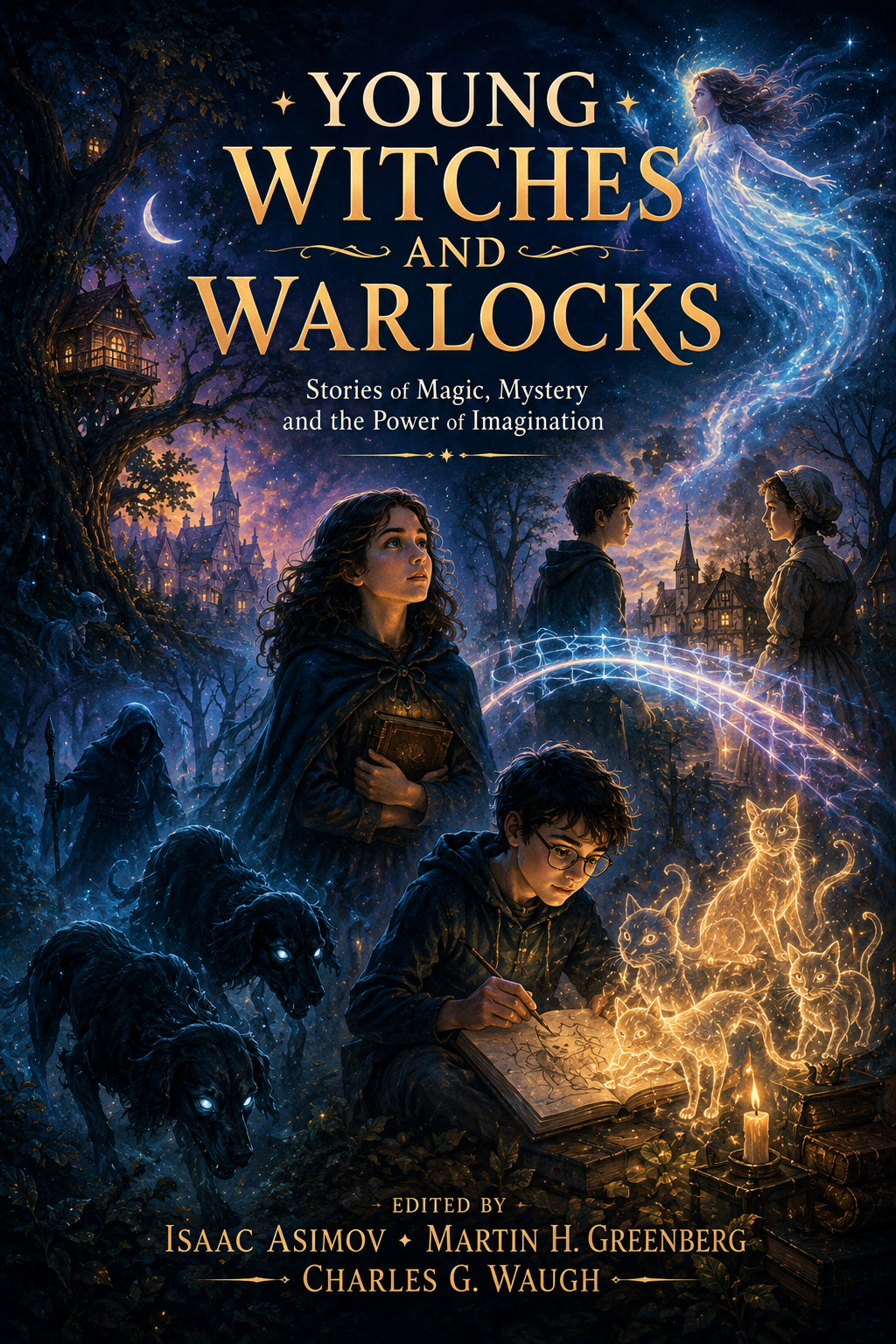
Young Witches and Warlocks is an enchanting anthology edited by Isaac Asimov, Martin H. Greenberg, and Charles G. Waugh that gathers ten stories about children and young people whose lives are touched by magic and imagination. Rather than presenting these figures as frightening, the collection explores them as dreamers and reluctant heroes. Each story stands alone, yet together they form a journey through childhood where the boundary between fantasy and reality is wonderfully uncertain. The book suggests that every child who sees the world differently already possesses a little magic.
The adventure begins with The April Witch by Ray Bradbury. Cecy is a young witch who possesses the unusual ability to leave her own body and enter the minds of animals and other people. This use of Telepathy allows her to experience the world through borrowed eyes. She spends a magical evening walking beside a young man she finds fascinating. Bradbury transforms this encounter into a meditation on first love and the universal wish to become someone else.
In Witch Girl by Elizabeth Coatsworth, magic becomes a symbol of individuality. The young heroine grows up among ordinary people while possessing abilities that set her apart. She struggles to understand if her gifts are blessings or burdens, discovering that fear often accompanies anything different. This story highlights the Sociology of how communities react to those who do not fit the norm. The story ultimately suggests that true power comes from kindness and self acceptance rather than spells.
The Wonderful Day by Robert Arthur introduces a child who discovers that reality bends effortlessly around his wishes. Every innocent thought seems capable of reshaping the world. What begins as a playful fantasy gradually reveals the enormous responsibility hidden within unlimited power. Arthur reminds readers that the imagination of a child can become the strongest magic of all.
With Four Lean Hounds by Pat Murphy shifts into darker territory while preserving the wonder of folklore. A young traveler encounters ancient forces and spectral hounds whose presence signals supernatural change. The protagonist must rely upon courage and instinct rather than strength. This story creates an atmosphere where shadows remember forgotten legends and bravery is measured by perseverance.
Mistress Sary by William Tenn approaches witchcraft with wit and satire. The mysterious Mistress Sary appears to possess extraordinary powers that unsettle an entire community. Through clever dialogue, Tenn examines the tendency of people to fear what they cannot explain. The story exposes how superstition often says more about the observers than the witches. By the conclusion, wisdom proves more valuable than enchantment.
In Teragram by Evelyn E. Smith, communication itself becomes magical. Strange messages travel through impossible channels to link ordinary lives with supernatural possibilities. The young characters discover that words possess power equal to spells and that understanding another person may be the greatest enchantment of all. Smith makes the extraordinary feel as natural as a quiet conversation.
Stevie and the Dark by Zenna Henderson offers an emotionally rich tale about the Psychology of childhood fear. Stevie is only a small child, but he senses terrifying things hidden within the darkness that adults dismiss as imagination. His innocence becomes both his greatest vulnerability and his greatest strength. As unseen forces gather, Stevie draws upon ancient protections and inner courage. The result is a moving story about resilience and the absolute nature of hope.
A Message from Charity by William M. Lee introduces a fascinating concept involving a psychic connection across time. A modern boy forms a link with Charity, a girl living during the Salem witch trials centuries earlier. They experience each other's lives as if seeing through different eyes across the dimensions of Spacetime. Charity glimpses a future where reason rules, while the boy witnesses the fear surrounding accusations of witchcraft. Their understanding transforms both lives and offers a reflection on tolerance and empathy.
The Entrance Exam by Mary Carey brings humor and excitement to the collection. A determined young girl dreams of entering a prestigious school for witches despite obstacles. Every test challenges her creativity and intelligence. Rather than relying upon spectacular spells, she succeeds through persistence and Logic. The story celebrates the value of determination over inherited talent.
The anthology concludes with The Boy Who Drew Cats by Lafcadio Hearn. A frail boy loves drawing cats so much that every surface becomes filled with his artwork. He finds shelter inside an abandoned temple haunted by a monstrous creature. During the night, the cats he has drawn mysteriously come alive to battle the unseen terror. This simple elegance leaves the reader with an image of creativity becoming literal salvation.
Read as a whole, Young Witches and Warlocks resembles a walk through a forest where every path reveals a different understanding of enchantment. All stories share the conviction that extraordinary gifts carry equally extraordinary responsibilities. The witches and warlocks are rarely villains but are children learning to navigate loneliness and friendship. Isaac Asimov's editorial vision suggests that magic is not an escape from reality but another way of examining it. The collection transforms witchcraft into a celebration of curiosity and the limitless possibilities of the young mind.