Devils
This collection reimagines the devil as a mirror for humanity, using logic and satire to demonstrate how individual responsibility and choice ultimately determine our fates.
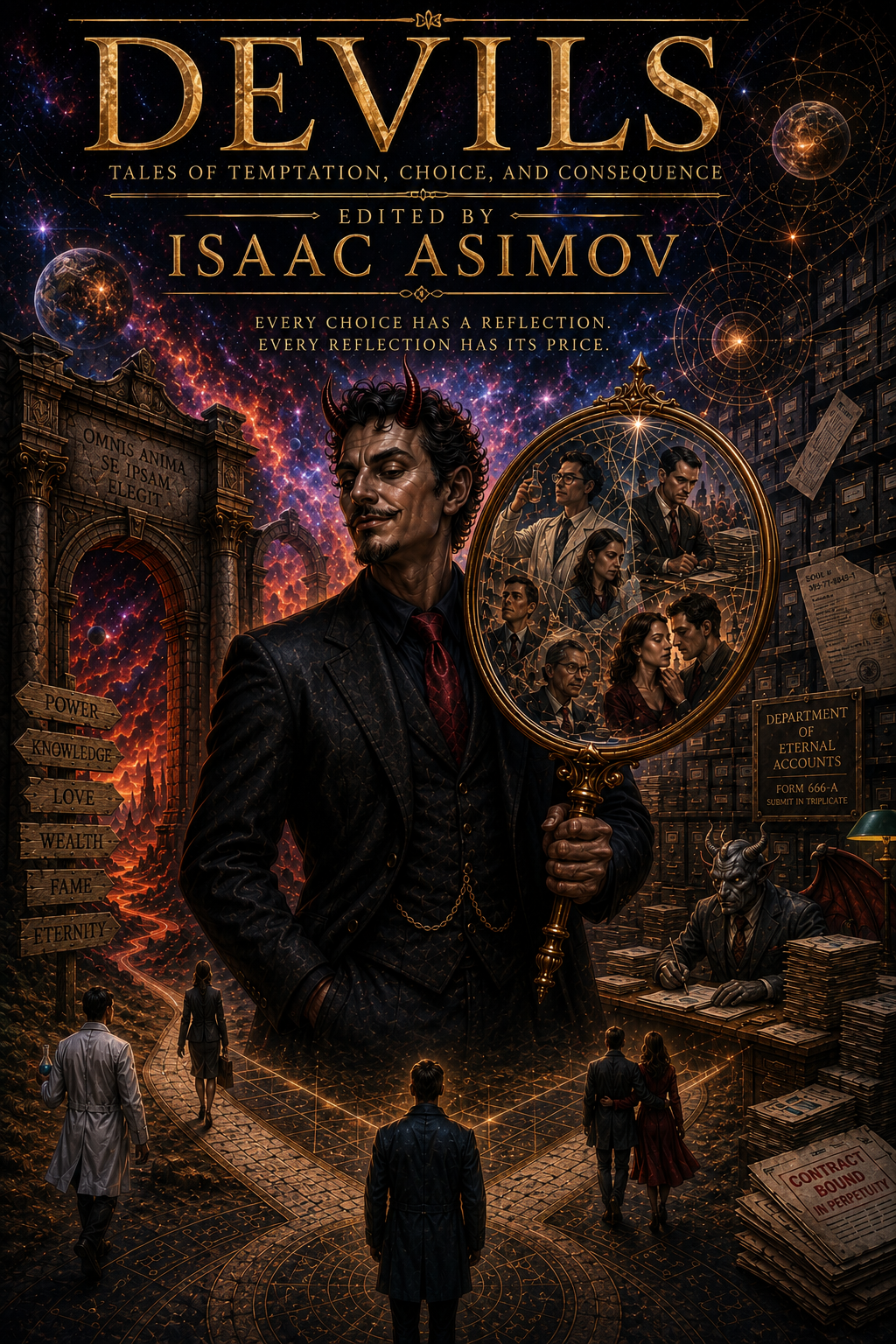
The idea of the devil is one of humanitys oldest inventions. Every civilization has imagined beings that tempt, deceive, punish, bargain, or simply observe the weaknesses of mankind. In Devils, the supernatural creature is not presented as a simple embodiment of evil but as a mirror that reflects human ambition, fear, greed, curiosity, love, and irony. The collection follows a tradition that values taking a familiar mythical figure and allowing many different writers to reinterpret it from unexpected angles.
Rather than relying on horror alone, the stories explore intelligence instead of terror. The devils found here are philosophers, businessmen, tricksters, bureaucrats, lonely immortals, and even reluctant servants of cosmic order. The result is a journey through fantasy, satire, science fiction, and dark comedy, where the greatest danger is usually not the devil himself but the human being who believes he can outsmart him.
The opening stories establish the classic image of the bargain with the devil. A desperate individual seeks wealth, power, youth, or forbidden knowledge and willingly exchanges something priceless in return. Yet the expected conclusion rarely arrives. Instead of emphasizing punishment, the stories ask whether people were already imprisoned by their own desires long before the devil appeared. The infernal visitor merely provides an opportunity, while the protagonist supplies the tragedy.
One recurring theme is that hell operates with remarkable efficiency. Demons maintain records, enforce contracts, process souls, and observe regulations that humans scarcely understand. Evil becomes an organized institution rather than chaotic destruction. This bureaucratic approach transforms traditional horror into clever satire. Readers discover that eternal damnation may involve paperwork, committees, and administrative procedures just as much as fire and brimstone.
Another group of stories portrays devils as eternal observers of civilization. Having watched empires rise and fall, they become fascinated by humanitys endless ability to repeat the same mistakes. Wars, revolutions, greed, and prejudice seem almost unnecessary from a demonic perspective because people accomplish sufficient destruction without supernatural assistance. In these tales, the devil becomes a weary commentator rather than an active villain, suggesting that mankind has become remarkably efficient at manufacturing its own suffering.
Several stories reverse expectations by making the devil the sympathetic character. He honors agreements while humans constantly search for loopholes. He keeps promises while mortals lie to one another without hesitation. These ironic reversals encourage readers to question conventional definitions of good and evil. If a devil faithfully fulfills every contract while a hero betrays friends for personal gain, where should moral judgment truly fall?
The collection also explores temptation through knowledge instead of material reward. Scientists, scholars, and magicians seek answers beyond ordinary understanding, believing that intellectual achievement justifies any sacrifice. Their discoveries often reveal that absolute knowledge carries unexpected costs. The universe becomes less comforting, certainty disappears, and the characters realize that ignorance occasionally protects sanity. The devil, therefore, serves not merely as tempter but as gatekeeper to truths humanity may not be prepared to confront.
Humor appears throughout the anthology, preventing the subject from becoming oppressively dark. Some devils are surprisingly practical, complaining about impossible workloads or incompetent assistants. Others negotiate with lawyers, politicians, or businessmen who prove far more dangerous than any demon. The comedy works because it places mythical beings into ordinary situations, allowing readers to recognize familiar human absurdities beneath supernatural disguises.
Many stories examine pride, the oldest and perhaps greatest temptation. Characters believe they possess exceptional intelligence, moral superiority, or magical ability, only to discover that arrogance blinds them to obvious dangers. The devil rarely needs overwhelming power, patience is enough. He waits while people convince themselves that ordinary rules no longer apply to them. Their downfall becomes self created, giving the stories a classical elegance that echoes ancient morality tales without becoming simplistic sermons.
Love also enters the infernal landscape. Some protagonists attempt to rescue lost souls, reverse death, or overcome impossible separation by making dangerous bargains. These stories introduce emotional complexity absent from simple tales of greed. The reader understands why the characters accept impossible terms, making their choices tragic rather than foolish. The devil becomes less a monster than a catalyst exposing the strength and weakness of human devotion.
Several stories expand the scale from individual temptation to cosmic conflict. Heaven and Hell appear as opposing systems whose struggle extends beyond human understanding. Yet even on this grand stage, ordinary people remain central. Their choices determine outcomes more effectively than armies of angels or legions of demons. The supernatural setting ultimately reinforces a deeply human message, morality is exercised through daily decisions rather than spectacular battles between absolute forces.
The anthology continually shifts tone. One story may deliver chilling suspense, the next quiet philosophical reflection, and the next sharp satire worthy of social comedy. This variety keeps the concept fresh while demonstrating the remarkable flexibility of the devil as a literary figure. He can inspire fear, laughter, pity, admiration, or intellectual curiosity depending upon the storytellers purpose.
As a whole, Devils is less interested in frightening readers than in encouraging them to think about responsibility. Evil is seldom presented as an external force invading innocent lives. Instead, it grows naturally from envy, ambition, selfishness, and the refusal to accept consequences. The devil offers possibilities, but humanity supplies intention. That subtle distinction gives the collection lasting power.
Reading the anthology feels like listening to a group of storytellers gathered around a fire, each taking the same legendary figure and revealing a different face beneath the horns. One devil is ancient and terrifying, another witty and civilized, another almost melancholy, yet all illuminate some aspect of the human condition. The supernatural becomes a tool for exploring psychology, ethics, and society.
The greatest achievement of Devils is its refusal to settle for a single definition of evil. It suggests that temptation changes with every age. Medieval souls may have desired kingdoms, modern souls seek influence, technology, or immortality, but the essential bargain remains unchanged, immediate satisfaction purchased with a future cost that seems distant until it arrives.
In the end, the collection leaves readers with a paradox worthy of a thoughtful editorial style. The devils themselves are fascinating, intelligent, and endlessly inventive, yet they never overshadow the true subject of the book. The real mystery is humanity, capable of extraordinary kindness and astonishing cruelty, forever balancing reason against desire. The devil merely waits at the crossroads, smiling patiently, while men and women decide for themselves which road they will take.