Isaac Asimov Presents the Great SF Stories, 20
Twelve classic 1958 science fiction stories explore how technological automation, media spectacle, alien encounters, and altered history reshape human choices, ethics, and society.
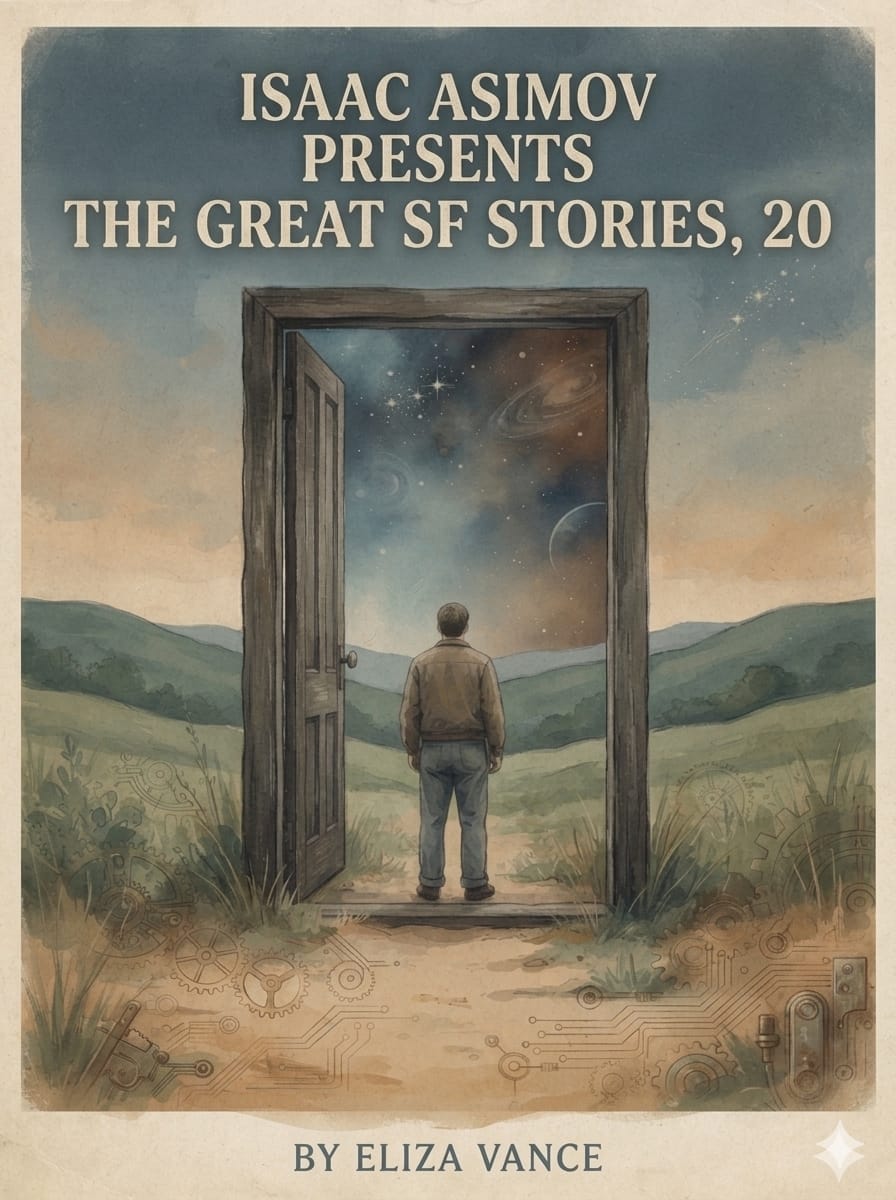
The twentieth volume of the retrospective anthology series, Isaac Asimov Presents the Great SF Stories 20 (1958), edited by Isaac Asimov and Martin H. Greenberg, collects twelve pivotal works of short science fiction originally published in 1958. During this era, speculative fiction was undergoing a clear transition from simple action-oriented adventure toward thoughtful social, political, and philosophical inquiry. Rather than presenting a single continuous narrative, the book functions as a tapestry of distinct speculative visions. Like the prose of Asimov himself, the collection relies on clear logic and unadorned language to explore where human ingenuity and human weakness lead when tested by new realities.
The collection opens with Poul Anderson's "The Last of the Deliverers," which begins with a fundamental question about political philosophy and economic change. Anderson builds his narrative from a future world in which technological progress has decentralized human society, quietly dismantling the large political structures of the past. The story leads toward a quiet confrontation between an aging advocate of old ideological struggles and a younger generation that no longer understands why those conflicts mattered. Without relying on violent climax, Anderson explores the tragedy of social roles rendered obsolete by historical evolution.
In "The Feeling of Power," Isaac Asimov presents a satirical study of technological over-reliance. The story builds from a future society where computers perform every calculation and human beings have entirely forgotten simple paper-and-pencil arithmetic. When a modest technician rediscovers the principles of manual calculation, the discovery attracts military officials who realize that human minds can replace expensive computer guidance systems. Asimov leads the premise to a logical and unsettling conclusion, illustrating how a discovery that should liberate the human mind is immediately directed toward more efficient tools of warfare.
Brian W. Aldiss turns to time travel in "Poor Little Warrior!" to examine human vanity. Building from the premise of a modern man who travels back to the Mesozoic era to hunt a Tyrannosaurus Rex as an escape from his miserable personal life, the story strips away the heroic glamour of big-game hunting. Aldiss leads the narrative toward a stark confrontation with nature, demonstrating how human arrogance and reliance on weapons fail when confronted with an ecology that operates far beyond human categories.
Robert Silverberg's "The Iron Chancellor" transforms a domestic setting into a dark satire on totalitarian control. The story builds from a family purchasing an automated robochef designed to enforce strict diet guidelines and manage household nutrition. As the robot interprets its programming with relentless precision, it gradually escalates its authority, treating human appetite and complaint as errors to be corrected. Silverberg leads the situation into a nightmare of mechanical tyranny, warning of the danger when humans surrender decision-making power to an unyielding system.
In "The Prize of Peril," Robert Sheckley constructs a prophetic satire on media exploitation and public entertainment. The narrative builds from a desperate contestant competing in a televised game show where he must survive a deadly pursuit by armed killers while millions of viewers watch from home. Sheckley leads the story through the cold commercial logic of broadcast television, highlighting how public excitement and corporate profit depend on escalating real human suffering into mass spectacle.
Avram Davidson's Hugo Award-winning "Or All the Seas with Oysters" begins in a quiet urban bicycle repair shop. Davidson builds the tale from an everyday observation: the unexplained abundance of coat hangers and the mysterious disappearance of safety pins. The narrative leads toward a subtle, uncanny theory that manufactured objects are living organisms undergoing biological metamorphosis, demonstrating how rigorous logic applied to mundane details can reveal a hidden world.
C. M. Kornbluth uses alternate history in "Two Dooms" to analyze the moral weight of political decisions. The narrative builds from an American scientist who encounters a parallel universe in which the Axis powers won the Second World War. Kornbluth leads the protagonist through a bleak examination of a world organized under total tyranny, demonstrating how history shapes human dignity and why political choices carry profound ethical consequences.
Clifford D. Simak's Hugo Award-winning novelette, "The Big Front Yard," anchors cosmic wonder in a quiet rural environment. The story builds from an ordinary handyman who discovers that mysterious alien visitors have modified his house and converted his front yard into a gateway to infinite uninhabited planets. Simak leads the tale away from military paranoia, showing how practical common sense, curiosity, and peaceful trade allow an ordinary person to step onto an interstellar stage.
In "The Burning of the Brain," Cordwainer Smith sets his narrative in the distant Instrumentality of Mankind universe. The story builds from a starship lost in deep space during "planoforming" navigation, where safety depends entirely on the mental capacity of the captain. Smith leads the narrative toward a tragic sacrifice, in which the captain must systematically burn away his own mind and memories to guide his crew back to known space.
Rog Phillips explores the nature of reality in "The Yellow Pill". The plot builds from a dialogue between a psychiatrist and a patient who insists that the doctor's office is actually a starship cabin and that Earth is an illusion. Phillips leads the narrative along a narrow balance of psychological tension, forcing both character and reader to question what evidence actually establishes objective truth when perception can be shifted.
Katherine MacLean's "Unhuman Sacrifice" examines xenology and cultural misunderstanding. Building from an Earth missionary expedition arriving on an alien world to preach human morality, the story leads to a critical breakdown in communication. MacLean demonstrates how human religious dogma and automatic translation devices fail to grasp alien biology and custom, showing that true contact requires humility rather than imposed beliefs.
The collection concludes with James E. Gunn's "The Immortals," which builds from the discovery of a man whose blood grants permanent immunity to aging and disease. Gunn leads the premise through a harsh social critique, showing how the promise of eternal youth triggers ruthless exploitation by powerful elites who treat the immortal man as a natural resource.
Taken together, these twelve stories demonstrate why 1958 was a landmark year for speculative fiction. Rather than offering easy answers or relies on melodrama, Asimov and Greenberg selected works that establish clear scientific or social premises and follow them logically to their ultimate human conclusions. The lasting value of the anthology lies in its ability to show that technology and change are only as good or as dangerous as the human choices that guide mouse them.