Other Worlds of Isaac Asimov
Asimov pairs science fiction with essays, exploring humanity and the cosmos to demonstrate how imagination and reason unite in the pursuit of knowledge.
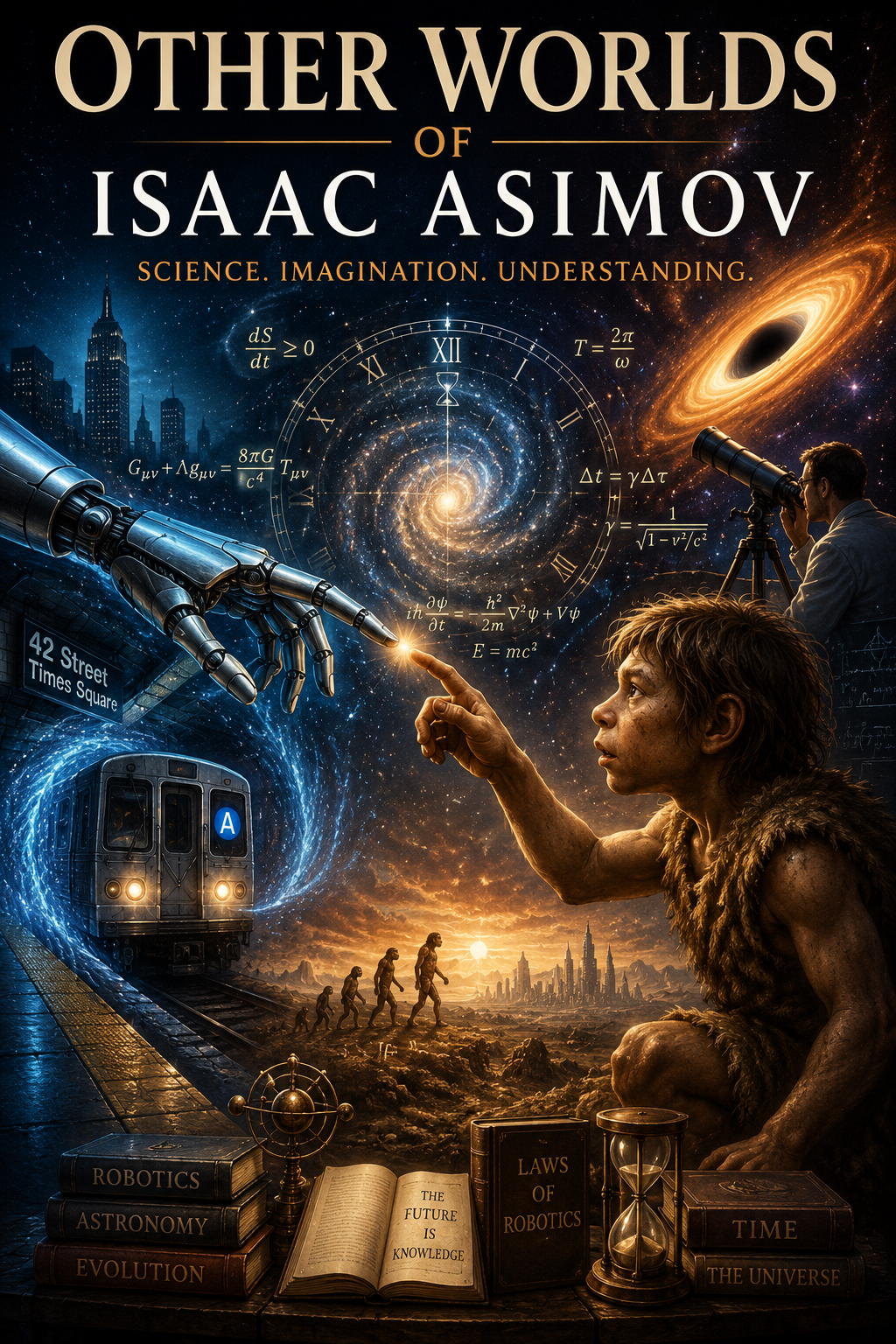
In the vast landscape of literature, there are those who build worlds out of nothing but dreams, and those who measure the world we already inhabit with the cold precision of logic. Isaac Asimov was a rare traveler who lived in both territories at once. In the collection titled Other Worlds of Isaac Asimov, he acts as a guide, leading us across a bridge that connects the imaginative what if of science fiction to the grounded how so of scientific fact. To read this book is to witness a conversation between a storyteller and a scientist, where every flight of fancy is tethered to a physical law and every scientific discovery is treated as the seed for a grand adventure.
The journey begins not in a distant galaxy, but in the most mundane of places: the New York City subway system. In the story The Little Man on the Subway, Asimov explores the idea that our perception of reality is often limited by our expectations. We see what we expect to see, and because of this, we are blind to the extraordinary things hiding in plain sight. He introduces a character who seems out of place, yet goes unnoticed by the rushing crowds. Through this mystery, Asimov suggests that the universe is far stranger than we realize, and that the only thing keeping us from discovering other worlds is our own failure to observe carefully. It is a theme that echoes throughout his broader work the idea that the universe is a puzzle waiting for a mind sharp enough to notice the clues others ignore.
From the subway, he moves to the laboratory in The Mad Scientist. Here, Asimov takes a familiar trope, the dangerous researcher, and turns it on its head. He presents a scientist who is not a villain driven by a thirst for power, but a human being driven by a thirst for understanding. The humor in the story comes from the gap between the public’s fear of progress and the scientist’s simple, almost absurd pursuit of curiosity. Asimov uses this to show us that science is a human endeavor, filled with both genius and folly. It serves as a reminder that knowledge itself is neutral; it is the responsibility of the person holding that knowledge that determines the outcome. This leads directly into his scientific discussions on how real world breakthroughs are often dismissed as madness before they become the foundation of our modern world.
Asimov then shifts his focus to the nature of time in The Red Queen's Race. This story is a logical exercise in causality, treating history like a complex mathematical equation. He explores the paradoxes of time travel not through flashy action, but through a chain of cause and effect that feels inevitable. The story builds from the question of whether an individual can truly alter the past or if the flow of time is a self correcting river. It leads the reader to a realization that time may possess an order that is far beyond human manipulation. In his accompanying essay, Asimov grounds this fiction in the real physics of relativity and the arrow of time, explaining why, despite our dreams, the past remains a closed book to us.
Perhaps the most emotional stop on this journey is The Ugly Little Boy. In this tale, Asimov looks back at our cousins in human evolution, the Neanderthals, by bringing a child from the past into the present via advanced technology. While the scientists in the story see the boy as a specimen to be measured and analyzed, his caretaker sees a child who feels fear, affection, and loneliness. The story builds toward a confrontation between scientific detachment and human compassion. It asks the reader to define what it truly means to be human. Is it our level of intelligence, or is it our capacity to care for one another?. This story leads into a deeper exploration of the fossil record, where Asimov clarifies the distinction between what we know from evidence and what we imagine about our ancestors.
The peak of the collection's philosophical inquiry is found in The Bicentennial Man. This story follows a robot named Andrew who begins as a machine built for service but develops a yearning for something more. Over the course of two centuries, Andrew seeks to transform himself, not just physically, but legally and socially. It is a story about the universal desire for acceptance and the definition of consciousness. Asimov uses his famous Three Laws of robotics as a framework, showing that technology should be designed to cooperate with humanity. Andrew’s journey is the ultimate other world the world of a machine that dreams of being a man. It leads to the profound question of whether mortality is the very thing that gives a life meaning.
Between these stories, Asimov provides essays that act as a map for the reader. He discusses stellar evolution, the possibility of life on other planets, and the future of our own civilization. He does not make wild predictions; instead, he examines trends in population, energy, and education, arguing that knowledge is our greatest resource. He reminds us that while the universe is vast and the distances between stars are daunting, our curiosity allows us to bridge those gaps.
In review, Other Worlds of Isaac Asimov is a masterclass in clarity and logic. Asimov’s strength is his ability to explain the complex without being condescending and to tell a story without being irrational. He demonstrates that facts and imagination are not enemies; they are partners in the pursuit of truth. By the end of the collection, the reader understands that other worlds are not just places in space, but new ways of thinking and seeing the world we already inhabit. It is a book that encourages us to look at the subway, the laboratory, and the stars with the same sense of wonder and the same demand for reason.