Little Treasury of Giant Dinosaurs (vol. 1)
Isaac Asimov explores giant dinosaurs as evolutionary living machines, using physical laws and fossil evidence to reveal how biological design made immense scale scientifically possible.
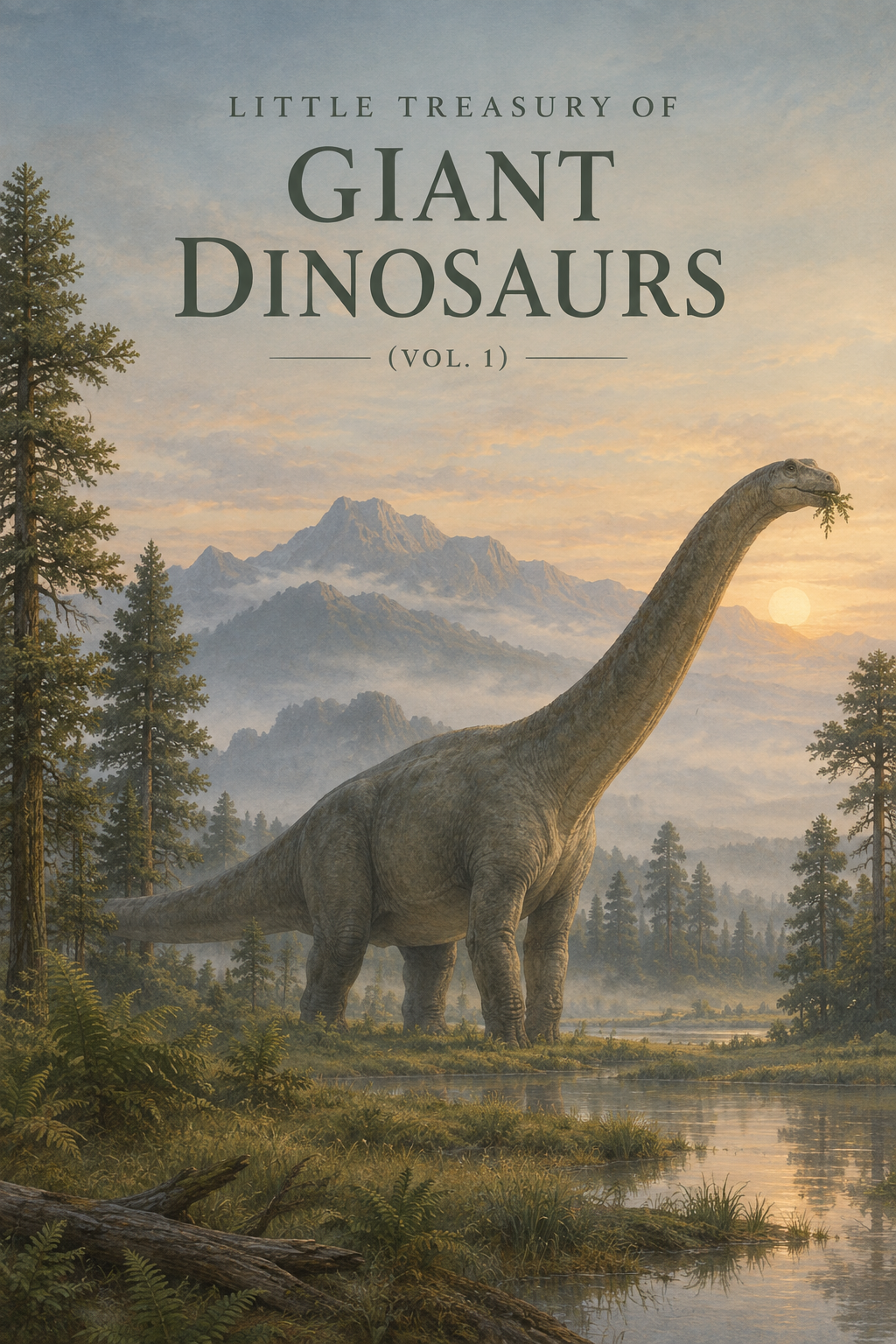
The grand narrative of prehistoric life opens with an invitation to step backward across millions of years into a world that feels simultaneously familiar and deeply alien. Imagine standing on an ancient landscape beneath unfamiliar skies, where forests and open marshes stretch to the horizon without a single city, road, or human being in sight. In the distance, a creature of unthinkable proportions moves across the terrain, dwarfing any land animal alive today. This startling vision serves as the entryway into Little Treasury of Giant Dinosaurs (Vol. 1), published in 1989 as the opening volume of Isaac Asimov's five volume series on prehistoric life. The book does not merely present a list of isolated facts; instead, it establishes an overarching narrative arc that begins with the sheer wonder of deep time and physical scale, builds through the mechanical logic of biological evolution, and leads directly to the birth of human scientific inquiry. In keeping with Asimov's established tradition of science writing seen earlier in works like his 1973 classic How Did We Find Out About Dinosaurs?, the story relies on simple words, clear logical steps, and everyday analogies to demonstrate that the massive bones of the past were governed by the exact same physical laws that rule our modern world.
To understand where this narrative builds from, one must begin with the fundamental puzzle of biological scale and geological time. Dinosaurs did not inhabit a brief, static moment in history; they flourished across vast, shifting epochs of Earth's ancient autobiography. Asimov structures the book's foundation around a central mystery: how could living, breathing animals attain such colossal dimensions without collapsing under their own weight? The answer unfolds like a carefully reasoned engineering document. A giant dinosaur was not a fantastical monster, but a living biological machine assembled by millions of years of evolution. Every feature of its body, from its pillar like legs and heavy ribcage to its specialized teeth, lungs, and blood vessels, represented a practical solution to the uncompromising demands of gravity, food intake, and energy distribution. Rather than overwhelming the reader with jargon, Asimov grounds this explanation in familiar physical concepts, showing that an immense body requires an equally immense supply of plant material, an extraordinarily efficient digestive system, and sturdy skeletal supports that function like living bridges or architectural columns.
Within this broader scientific narrative, the book explores several distinct mini stories, each focusing on a specific giant and the unique biological problem it solved. The first of these mini stories centers on Diplodocus, a classic long necked herbivore whose name refers to the double beamed bone structure found in its tail. Stretching roughly twenty seven metres from nose to tail, Diplodocus was built less for speed or active pursuit and more as a giant, continuous plant eating machine. With its small head, elongated neck, massive four legged stance, and sweeping tail, the animal demonstrated how evolutionary design could favor sheer length over predatory agility, allowing a herbivore to sweep across vast areas of vegetation while expending minimal energy.
The second mini story turns to Brontosaurus, the famous "thunder lizard," whose very name evokes the immense physical presence of heavy land giants. While Diplodocus captured the imagination through its incredible length, Brontosaurus illustrated a completely different aspect of scale: sheer mass and heavy body volume. Its thick, heavy frame meant that its footsteps would have felt like localized thunder to any nearby creature. Through this comparison, Asimov teaches a vital lesson in logical classification, showing young readers that "bigness" in nature is not a single dimension, but can be achieved through length, height, or concentrated body weight.
The third mini story highlights Brachiosaurus, the "arm lizard," an animal that solved the problem of reaching high canopy vegetation through a radical departure from typical quadruped anatomy. Unlike most four legged animals whose hind limbs are longer than their front limbs, Brachiosaurus possessed unusually long forelegs. This structural adaptation raised its shoulders high off the ground, elevating its long neck toward the treetops like a living tower. Yet, as Asimov logically demonstrates, this magnificent height introduced severe biological costs: a longer neck required enormous energy to pump blood upward, and an immensely heavy body demanded a staggering daily intake of plant foliage containing tough cellulose. Brachiosaurus thus stands as a vivid example of evolution balancing massive structural advantages against strict physical limits.
The final mini story introduces a sharp contrast in the form of Tyrannosaurus, the fearsome meat eating predator. Measuring nearly fifteen metres in length with a massive skull and bone crushing teeth, Tyrannosaurus represented the upper limit of carnivorous size. However, Asimov highlights a crucial ecological truth that challenges common assumptions: despite its terrifying reputation, even the largest predatory dinosaur was surpassed in total mass by the greatest plant eating herbivores. Being a giant herbivore allowed an animal to turn abundant plant life into massive body weight that acted as natural armor against attack, whereas a giant carnivore faced severe energetic constraints, as it had to hunt and capture other living animals to sustain its massive body.
Having traced these individual biological experiments, the narrative moves logically toward how the age of giant dinosaurs reached its natural limits and where the story leads today. No matter how successful these living bridges and giant machines were, their existence remained tightly bound to Earth's environmental conditions, including climate, vegetation availability, and competition. As geological time marched onward, ancient forests altered and landscapes vanished, bringing an end to evolution's grandest experiment in terrestrial size. Yet, their story did not end in total oblivion. Over millions of years, the soft tissues decayed, but the massive bones were preserved in layers of rock, waiting to be unearthed in our modern era.
This transition marks the ultimate destination of Asimov's narrative arc: the transformation of prehistoric wonders into modern paleontology. The book skillfully redirects the reader's focus from the initial childhood question of "How big was this dinosaur?" to the far more profound question: "How could an animal this large live?". The buried fossils, a massive femur, a piece of jaw, a set of vertebrae, become historical clues that human beings use to reconstruct creatures no living person ever witnessed. Asimov emphasizes that science is an evolving process where incomplete remains require careful interpretation, and where scientific conclusions grow stronger, rather than weaker, whenever new evidence leads to corrected estimates. The narrative reaches its resolution not with the roaring action of a monster movie, but with a quiet, thoughtful moment: a human being standing beside a reconstructed skeleton in a museum, disciplined by evidence, and embarking on the journey of scientific inquiry.
In evaluating Little Treasury of Giant Dinosaurs (Vol. 1) as a work of science literature, its greatest triumph lies in its seamless blend of wonder, logic, and scientific humility. Written in clear, accessible prose without unnecessary jargon or complex fluff, the book reflects Asimov's signature ability to demystify complex subjects while preserving their awe inspiring nature. By using familiar visual comparisons, measuring weight in terms of pillar like support and length in terms of physical structures, the text turns abstract measurements into vivid mental pictures. Furthermore, the book quietly instills a sense of critical scientific thinking, reminding young readers that our understanding of the ancient past is always open to revision as new discoveries emerge. Ultimately, Asimov takes a subject that often exists in popular culture as pure fantasy and reveals a far deeper truth: that the real, natural world governed by physics and biological evolution is vastly more fascinating than any fiction.