Our Milky Way and Other Galaxies
MoreHumanity's cosmic perspective expands from Galileo resolving the Milky Way's stars to Hubble discovering countless other island galaxies across a vast universe.
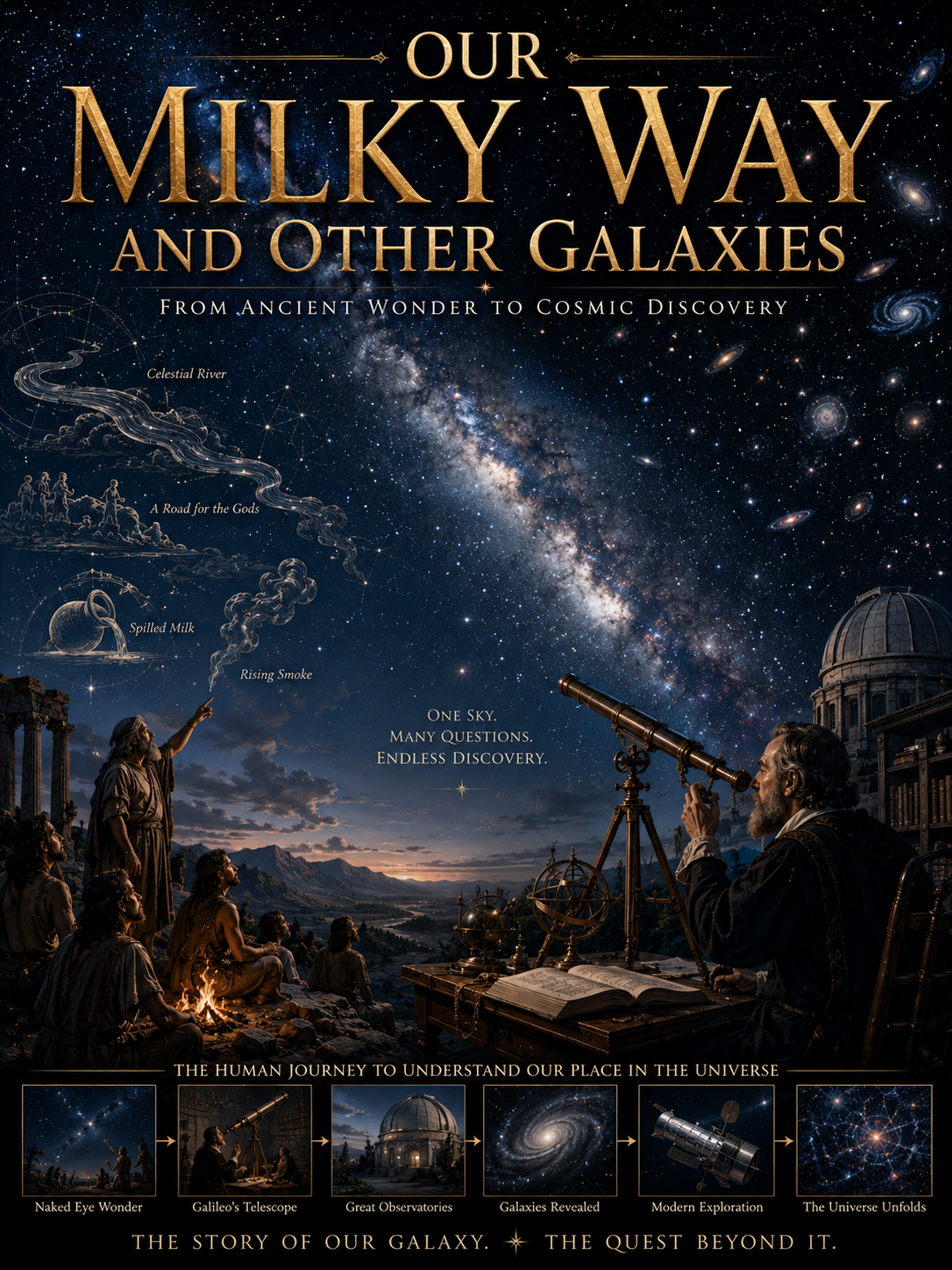
The journey in Our Milky Way and Other Galaxies begins with early humans standing under the dark night sky, looking up at a pale, mysterious band of mist that stretched from horizon to horizon. They created beautiful myths to explain this glowing path, imagining it as a celestial river, a road for the gods, spilled milk, or rising smoke. But the true story began to build when Galileo Galilei first pointed an early telescope at this hazy band, revealing that it was actually a vast collection of countless individual stars packed tightly together. This single, elegant observation transformed ancient mythology into modern science, setting humanity on a relentless path of cosmic exploration.
As this intellectual story progresses, astronomers tried to map the shape of this immense stellar system. They counted stars in different directions and gradually realized they were situated inside a flattened disk, with our own Solar System located far from the crowded galactic center, nested within one of the galaxy's graceful spiral arms. Copernicus had already shown that the Earth was not the center of the Solar System; now, the Sun lost its privileged, central position in the stellar family as well. The galaxy revealed itself as a diverse home of stars, ranging from hot blue giants to long lived red dwarfs, often bound together in binary systems or massive star clusters. All of them, however, maintained a delicate balance between the inward pull of gravity and the outward push of nuclear fusion.
Reconstructing this cosmic home from the inside was like trying to understand the shape of a massive forest while standing among its trees. Interstellar dust blocked visible light, but scientists found ways to peer through the darkness using radio waves and infrared observations, mapping the hidden regions and showing that the galaxy is a dynamic, evolving system in constant motion. Stars orbited the galactic center, gas clouds collapsed to form new stars, and supernovas scattered heavy elements to enrich future generations of stellar systems.
The narrative then builds toward its ultimate climax with the great nineteenth century debate over the nature of spiral nebulae. For a long time, astronomers argued whether these faint, cloudy spirals were small objects inside the Milky Way or separate stellar systems situated unimaginably far away. This mystery was solved when Edwin Hubble measured variable stars inside the Andromeda Nebula, proving that it lay far beyond our own galactic borders. Instantly, the known universe expanded beyond all prior imagination. The Milky Way was no longer the entire universe, but just one single island galaxy floating in a vast, endless cosmic ocean of hundreds of billions of other galaxies.
The final chapters of this cosmic tale reveal the incredible variety of these newly discovered islands, from spirals and ellipticals to irregular shapes distorted by gravity. We learn that galaxies are social, gathering into clusters and superclusters, with our own Milky Way residing in a modest collection called the Local Group. This vast network forms a cosmic web stretching across light years, where looking at these distant realms means looking backward through time, as the light we see left them millions of years ago. The story concludes with a humbling, yet inspiring outlook: in a universe filled with hundreds of billions of galaxies, our planet is but a tiny corner, yet the human mind has proven capable of deciphering this grand, magnificent cosmic tapestry.