Norby and the Invaders
Jeff Wells and Norby investigate mysterious invaders. Norby’s unique intuition bridges understanding gaps, proving adaptability triumphs over rigid logic in an unpredictable universe.
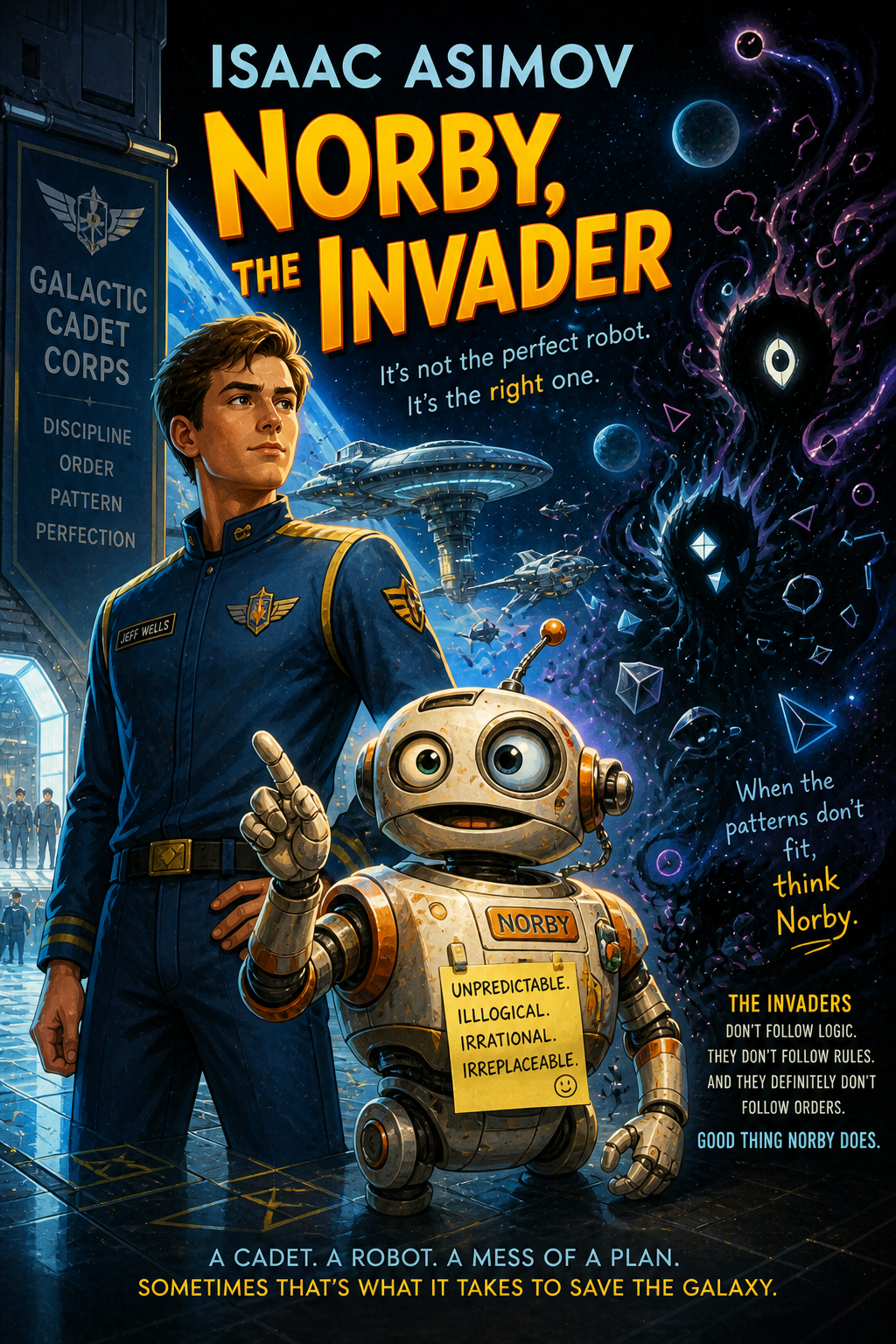
The story of Norby and the Invaders begins not with a grand explosion or a declaration of war, but with a quiet and deliberate introduction of a fundamental problem. In the vast, structured future of space travel and advanced technology, there is a certain expectation of order and predictability. We have grown accustomed to the idea that machines should be precise and that human systems of authority should have clear answers for every crisis. This book, however, chooses to explore what happens when those rigid patterns of thought are confronted by something that does not fit the mold. It is a narrative that builds from a premise of stability and leads toward a realization that flexibility is perhaps our greatest asset.
At the center of this narrative is Norby, a robot who serves as a living contradiction to the standards of his kind. While we might expect a robot in an Isaac Asimov story to be a pillar of logical certainty, Norby is presented as essentially imperfect. He is a machine that feels, reacts with emotion, and makes mistakes that seem entirely inconsistent with strict programming. Yet the story suggests that Norby is not a broken tool, but rather a profound question: what is the value of a robot that does not fit the pattern? Alongside him is Jeff Wells, a young cadet who serves as the steady anchor to Norby’s erratic behavior. Their partnership is the foundation of the book; Jeff provides the interpretation and stability while Norby provides the movement and the unconventional insight.
The conflict arises when reports begin to surface regarding the invaders. In a move that favors psychological tension over spectacle, the story does not immediately define these entities. Instead, they are introduced through uncertainty. Reports of their movement and influence create a framework of speculation—are they hostile, are they intelligent, or are they something else entirely? This uncertainty forces the characters to operate within a system that no longer provides clear data, showcasing how human authority often struggles when confronted with ambiguity. The narrative moves away from the simplicity of a physical conflict and instead shifts toward a process of interpretation. The invaders are not just enemies to be fought; they are a challenge to the established assumptions of the human characters.
As the story progresses, it follows an episodic structure that allows it to explore different facets of this central problem without losing its logical clarity. Although the book does not contain formal, separate mini stories, several distinct thematic segments function as self contained explorations of the human and robotic condition.
The first of these thematic segments is Perception. There is a sequence where Norby reacts to a routine situation with a level of intensity that others find irrational or disproportionate. To the human observers, it looks like a malfunction. However, the story reveals that Norby’s imperfect nature allows him to perceive underlying patterns that a more rigid, logical mind would miss. These deviations from standard logic are not actually errors, but are instead clues to a deeper reality. It suggests that sometimes, the most accurate way to view a complex universe is through a lens that is not strictly linear.
A second segment is Authority and Uncertainty. In this part of the journey, the focus shifts to the leaders and systems designed to maintain order. These authorities demand definitive answers and predictable outcomes, but the presence of the invaders makes such certainty impossible. Asimov uses this to show how rigid systems respond to the unknown. The story highlights the tension between the need for immediate action and the reality of incomplete information. It becomes clear that the traditional structures of command are ill equipped for a situation that does not follow the rules.
The final thematic segment is Communication and Understanding. As the nature of the invaders begins to emerge, the characters realize that these beings are not driven by human aligned motives. The problem is no longer one of resistance, but one of translation. Norby’s role is vital here because his ability to move beyond strict logic allows him to bridge the gap between human expectations and alien behavior. He helps to reconfigure the understanding of those around him, turning a potential catastrophe into a lesson in adaptability.
The review of this work must acknowledge that while it may appear lighter than some of Asimov’s more dense philosophical treatises, it remains deeply rooted in his signature logical structure. The tone is accessible and often playful, yet the narrative never abandons its methodical progression from premise to consequence. It is a story that argues against the sufficiency of rigid patterns in a universe that is constantly presenting new variations. The resolution is not a final, triumphant conclusion where every mystery is solved and the invaders are defeated in a traditional sense. Instead, the situation is clarified, the immediate tension is eased, and the characters are left with a new method for facing the future.
Ultimately, Norby and the Invaders is a meditation on the logic of the imperfect. It suggests that Norby’s unpredictability is not disorder, but a higher form of adaptability. In the quiet, logical manner that defines Asimov’s legacy, the book leads the reader to reconsider their own assumptions about what it means to be functional and what it means to understand the other. The story ends with a continuation rather than a full stop, reminding us that the journey toward understanding is ongoing and that we must remain open to surprise. It is a modest yet substantial work that reinforces the idea that precision alone is not enough to navigate the complexities of existence; one also needs the flexibility to adapt to the unpredictable.