Norby Down to Earth
Cadet Jeff and his quirky robot Norby return to Manhattan, solving a mysterious robot disabling crime wave driven by human resentment while testing their friendship.
The stars have always beckoned to humanity, representing a future filled with logical progression and advanced technology. In the universe of science fiction, few have shaped this future as clearly as Isaac Asimov, whose legendary works explored the strict, intellectual rules governing robotic behavior. Yet, there is another side to the future, one that is lighter, warmer, and distinctly down to Earth. This is the realm of the Norby Chronicles, a series of humorous children's science fiction novels created through the collaboration of Janet and Isaac Asimov. The seventh book in this series, Norby Down to Earth, brings the grand adventures of outer space back to the familiar streets of Manhattan, building upon a rich foundation of science fiction history while steering toward a deeply human conclusion.
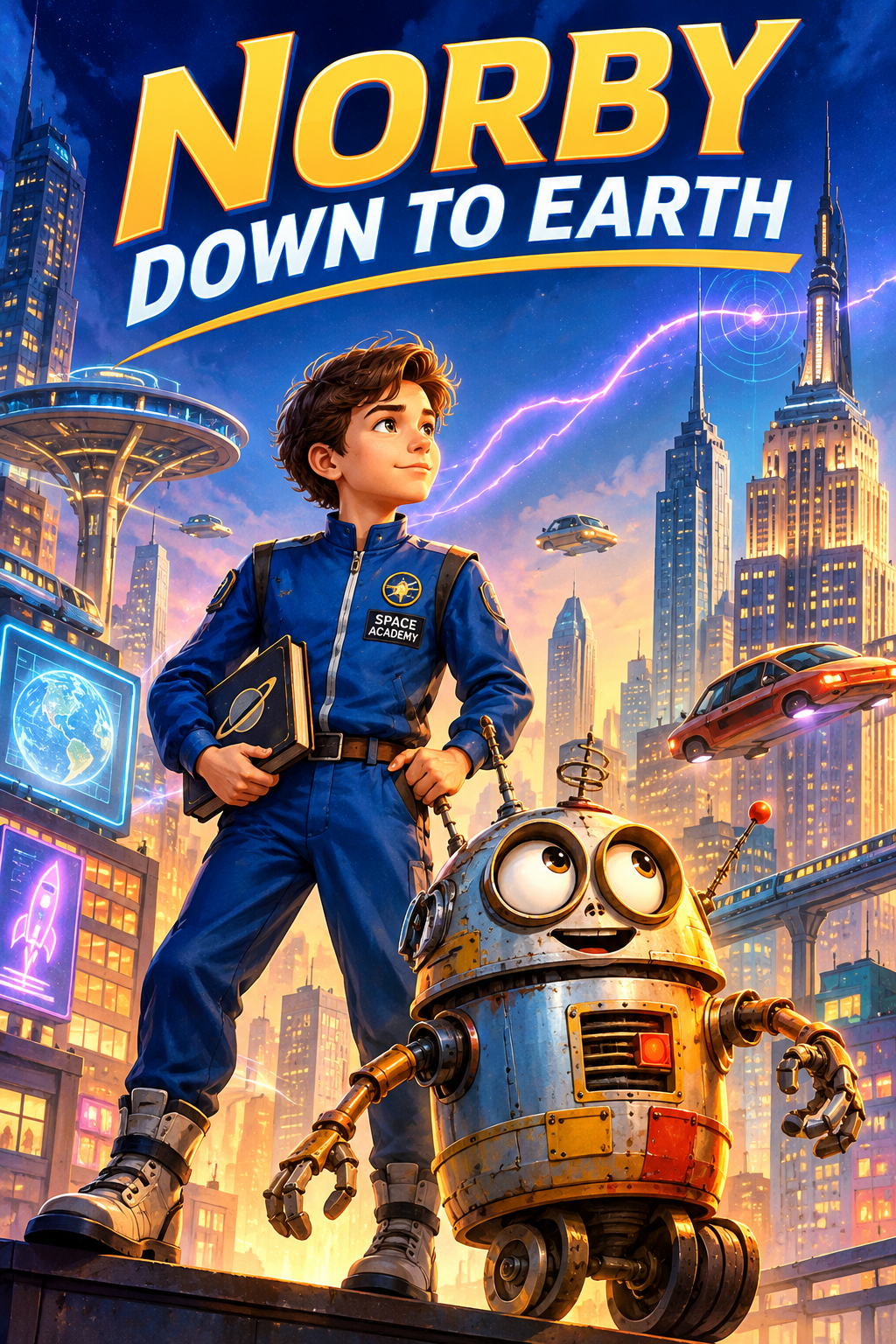
Our story begins far from the soil of Earth, within the structured walls of the Space Academy. Here we meet Jeff Wells, a practical young cadet who is trying his best to behave responsibly as a major space dynamics examination approaches. Jeff represents the typical logical protagonist, seeking order and academic success in a highly advanced future. But logic is constantly challenged by his companion, Norby, an extraordinarily capable but "mixed up" robot. Norby does not behave like the traditional, silent machines of early science fiction, nor does he possess the rigid, predictable intellect of Asimov's famous positronic robots. Instead, Norby is unpredictable, enthusiastic, and prone to creating magnificent complications. Their relationship lies at the very center of the narrative, establishing a bridge between human responsibility and chaotic, robotic innocence.
The peaceful routine of academic preparation is shattered by a call from home. Jeff learns that his older brother, Fargo Wells, has been injured and is in trouble back on Earth. Faced with a choice between academic advancement and family duty, Jeff chooses his family. Alongside Norby, he departs the academy and heads for Manhattan, beginning a journey that will test their resourcefulness. What starts as a simple, practical mission to help an injured sibling quickly becomes entangled in a dark and baffling urban mystery.
To understand where this story is building from, one must look at the historical themes of robotic integration. In many classic science fiction works, robots are either viewed as dangerous tools or as perfect, logical servants. In Norby Down to Earth, however, the mechanical residents of Manhattan are harmless, everyday helpers. Yet, a strange shadow has fallen over them. Someone is using a mysterious device to "zap" these robots, disabling them instantly. At the same time, computer components are being stolen from local stores. On their own, these two occurrences seem completely separate. Why would anyone want to disable peaceful machines? And what could a thief be building with stolen computer parts? Jeff and Norby find themselves drawn into this double mystery, where advanced technological power is being used for unknown, secretive ends.
Rather than unfolding as a single continuous line, the narrative is built out of several connected episodic segments that function as a series of mini stories, each advancing the overall mystery while building toward a critical climax.
The first of these connected segments is The Return to Earth, which establishes the emotional stakes of the adventure. We see Jeff's willingness to sacrifice his academic standing at the Space Academy to rush to Manhattan to aid his brother Fargo. This segment grounds the science fiction setting in genuine human values, showing that even in a future of spaceships and academies, family loyalty remains paramount.
The adventure transitions into The Robot Zapping Mystery, where the detective element of the story begins in earnest. As Jeff and Fargo attempt to understand the larger pattern of the disabled machines, they notice the curious overlap with the stolen computer parts. The thefts suggest that someone is actively constructing or repairing something complex, while the attacks on the robots suggest the use of a highly sophisticated, disruptive weapon.
Meanwhile, The MacGillicuddy Investigation shifts the focus to Norby's internal journey. Norby has always been intensely curious about his own unusual origins. Unlike the standard robots manufactured on Earth, Norby contains highly advanced technology connected with the mysterious alien race known as "the Others". This technology was incorporated into him by his eccentric human inventor, Moses MacGillicuddy. Driven by a desire to understand his own unique nature, Norby decides to research his maker's life and write a biography, turning the quest for external clues into a deeply personal search for identity.
The search leads our companions to The Higgins House, an old Manhattan landmark that once had close connections to Moses MacGillicuddy. This historic home contains crucial clues about the inventor's complicated past. Within its walls, the historical mystery of Norby's creation and the modern mystery of the disabled robots begin to overlap, bringing the characters closer to the source of the disruption.
This leads directly into The Miss Mynn Mystery, which introduces MacGillicuddy's daughter. Miss Mynn is an emotionally complicated person who carries a deep resentment toward her father's memory. She feels that her father valued his robotic creations, especially Norby, far more than he valued his own daughter. A portrait her father painted of her becomes a powerful symbol of her feelings of neglect and abandonment. Through this emotional conflict, the story reveals that the technological threat facing the city's robots is not born of a grand conspiracy for power, but rather from a very human sense of hurt.
The narrative reaches its most suspenseful point in Norby's Deactivation. The mysterious zapping weapon is eventually turned against Norby himself, leaving him completely deactivated and silent. This is a devastating blow for Jeff. Norby is not merely a piece of equipment; he is Jeff's companion, teacher, and loyal friend. The terrifying possibility that Norby may have permanently lost his memories and unique abilities forces Jeff to cast aside his role as a mere investigator. He must become a rescuer, embarking on a desperate race against time to use the clues of the stolen computer parts to repair his friend before his condition becomes irreversible.
In reviewing Norby Down to Earth, we can see how the story beautifully leads toward a profound lesson about the nature of technology and humanity. While Isaac Asimov is famous for his serious, intellectually rigorous robot novels that focus on logical paradoxes, this collaboration with Janet Asimov takes a different path. It is a lighthearted, playful mystery that prioritizes emotional resonance over dry scientific rules.
The book's greatest strength is its perspective on progress. It reminds us of a timeless Asimovian idea: advanced technology does not automatically lead to advanced human behavior. A person can possess an extraordinary scientific device and still use it to act out of basic, unresolved human emotions like jealousy, resentment, and grief. Scientific progress may grant us astonishing powers, but it does not make us inherently wiser or kinder.
Ultimately, the story suggests that being "down to Earth" is not just about a spacecraft landing on a planet. It is about returning to the fundamental values that make life worth living: family, friendship, loyalty, and the willingness to save those we care about. Norby may possess the incredible capability to travel through hyperspace, but his most important asset is the simple fact that he and Jeff care for one another. It is this deep, reciprocal friendship that transforms a mystery about zapped machines into a warm, clear, and logical adventure about what makes any soul, robotic or human, truly worth saving.