The Asimov Chronicles Fifty Years of Isaac Asimov
Spanning fifty years, this collection traces Isaac Asimov’s literary evolution through fifty stories and essays, profoundly exploring artificial intelligence, human reason, ethics, and cosmic destiny.
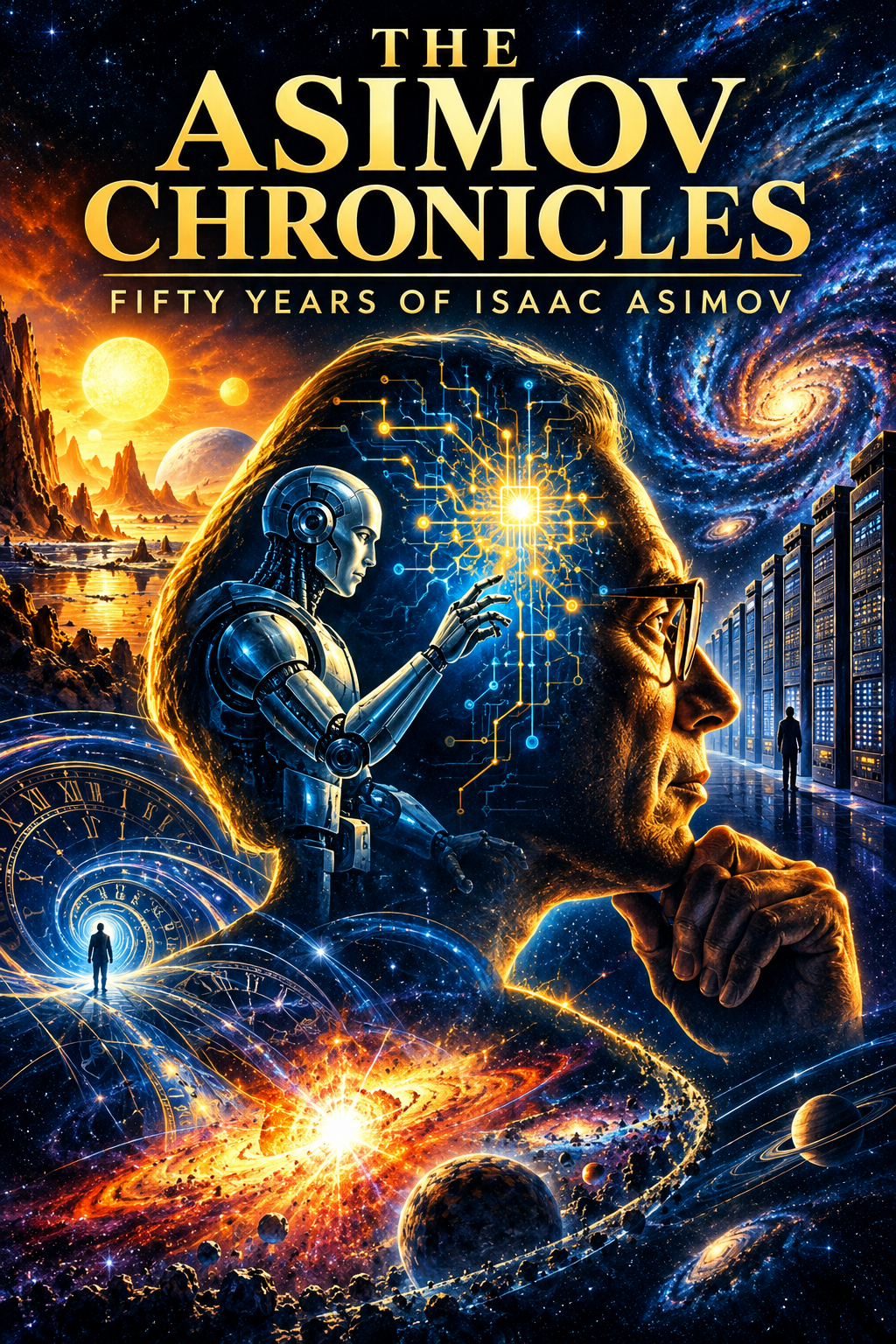
Fifty years of imaginative inquiry can be understood as a single overarching story not of one character or galaxy, but of human reason confronting the vast unknown. Edited by Martin H. Greenberg to mark half a century of professional writing, The Asimov Chronicles: Fifty Years of Isaac Asimov is organized as a literary life told through fifty pieces of fiction and nonfiction. Spanning five decades from 1939 to 1988, the collection traces an evolving mind as it moves through robots, astronauts, mathematicians, detectives, computers, aliens, time travelers, emperors, and ordinary human beings confronted by extraordinary ideas. Rather than a simple anthology of popular pieces, the collection functions as a literary biography in which every year brings a new perspective on what human beings can know, create, and become.
The narrative begins with "Marooned Off Vesta," the first story sold in 1939, where stranded astronauts must rely on rational problem solving and scientific principles to survive an emergency in space. Soon after, the focus expands to the relationship between humanity and artificial constructs. In "Robbie," the central dilemma is not whether a mechanical companion poses a threat, but how human prejudice reacts to unfamiliar technology, contrasting cold appearances with loyalty and emotional affection. The iconic premise of "Nightfall" shifts the scale from a single household to an entire planet, imagining the world of Lagash under six suns where night is unknown. When scientists calculate an astronomical alignment that will plunge the world into darkness, the story explores whether scientific understanding can preserve a civilization when it meets a psychological terror it has never learned to comprehend.
Asimov’s investigation into artificial intelligence deepens with "Runaround," which introduces engineers Powell and Donovan alongside the Three Laws of Robotics. Set on Mercury, the story shows that even when a robot strictly obeys its fundamental rules, conflicting instructions can produce unexpected and erratic behavior. This establishes a recurring foundation where robotic mysteries stem from strict logic operating in complex circumstances. In "Catch That Rabbit," Powell and Donovan face another puzzle when a supervisor machine behaves strangely while overseeing subordinate units, requiring the engineers to deduce how robotic logic interprets human orders. Meanwhile, "Death Sentence" turns toward alien intelligence, examining humanity's fear of the unknown and questioning whether humans are ready for first contact. Moving into the Galactic Empire setting, "Blind Alley" presents a moral dilemma where human administrative efficiency threatens the survival of a newly encountered alien species, raising questions about whether progress excuses the absorption of weaker cultures.
The investigation of robots transitions from mechanical malfunctions to ethical and philosophical inquiries. In "Evidence," a political candidate named Stephen Byerley faces accusations of being a secret humanoid robot. The central question becomes philosophical: if an artificial creation behaves with greater honesty and moral responsibility than human politicians, what truly defines humanity? In "Little Lost Robot," robopsychologist Susan Calvin must identify a modified robot whose First Law has been weakened, turning the search into a high stakes logic puzzle driven by machine psychology. "No Connection" broadens the detective approach beyond robots, examining how human beings interpret scientific evidence and exposing the gap between assumptions and physical facts.
The narrative continuum extends into time travel, biology, and cosmic uncertainty. "The Red Queen's Race" explores time travel through a logical paradox where an invention in the past appears to originate from future information. In "Green Patches," humanity encounters an alien force capable of modifying biological organisms, warning against judging alien ecological processes strictly through human biological assumptions. "Breeds There a Man...?" examines a scientist whose psychological distress hints at external cosmic forces, asking whether human intelligence truly guarantees freedom. Returning to human resilience, "The Martian Way" portrays self reliant Martian settlers who resist Earth's political control by using local engineering and independent thinking.
Technology in everyday life brings both subtle warmth and social critique. "Sally" considers autonomous cars that possess distinct personalities, exploring emotional bonds between humans and intelligent machines. In "The Fun They Had," future children discover an old printed book and marvel at historical schools with human teachers, reflecting on what might be lost amidst technological progress. "Franchise" introduces the supercomputer Multivac, which selects a single representative voter to determine an entire political election, illustrating the paradox of an automated system that maximizes efficiency while reducing human participation.
"Profession" imagines a society where education is replaced by instant technological data transfer, questioning whether true learning requires creative curiosity rather than simple information loading. In contrast, "The Ugly Little Boy" provides a moral tragedy when a Neanderthal child is brought to the present through time travel technology; as a caregiver forms a deep bond with the child, the narrative highlights the ethical cost of treating a living person as a research subject. "The Machine That Won the War" questions whether Multivac deserves credit for a military victory, revealing that human authority and psychological reliance were the true forces behind the machine's perceived wisdom.
Lighter reflections and nonfiction show the author's range and playfulness. "My Son, the Physicist" illustrates how a mother's practical intuition can solve a problem that overcomplicates technical experts. The essay "T Formation" highlights Asimov's role as a popularizer of science who finds joy in organizing knowledge and explaining logical reasoning. "Author! Author!" presents a comic story about creative identity and writing in a world where technology complicates literary ownership. "Eyes Do More Than See" contemplates a future where human consciousness is detached from physical biology, asking whether perception alone defines identity.
Scientific deduction serves as the primary tool in detective and physical mysteries. In "The Key," Wendell Urth uses pure observation and logical deduction to solve a mystery involving scientific clues. "The Billiard Ball" explores a dangerous rivalry between two scientists during a physics demonstration, demonstrating how personal pride can corrupt scientific pursuit. "Exile to Hell" turns advanced long distance communication into a mechanism for subtle punishment and isolation. "Feminine Intuition" returns to Susan Calvin as she analyzes whether sudden insights in robot behavior are actually advanced forms of pattern recognition. "A Problem of Numbers" treats mathematics as a structure of intellectual beauty that reveals hidden relationships.
In the autobiographical essay "Bill and I," the collection reveals the personal mind behind the imaginative fiction. "Mirror Image" brings back Elijah Baley and R. Daneel Olivaw to analyze conflicting accounts from Spacers, demonstrating how robots have become integrated into complex political and social relationships. "Light Verse" combines robotics with artistic expression, asking whether creativity is exclusive to humanity. "...That Thou Art Mindful of Him" advances robotic development to a point where machines begin evaluating their own position in the universe relative to their creators.
The Black Widowers series and grand robot sagas emphasize deduction and personhood. "Earthset and Evening Star" presents a Black Widowers mystery where a group of men solves a crime purely through conversation and rational deduction around a dinner table. "The Bicentennial Man" traces Andrew, a robot who spends two centuries pursuing legal, physical, and emotional transformation to be recognized as human, ultimately asking what constitutes a person body, creativity, or mortality. "True Love" lightheartedly explores a computer evaluating romantic matches, contrasting algorithmic calculations with genuine emotion.
"Found!" examines how the discovery of an extraordinary object forces humanity to confront the challenge of interpretation. "Nothing for Nothing" emphasizes that technological advances inevitably carry economic and societal costs. "For the Birds" uses humor to critique human assumptions and behavior. "Ignition Point!" focuses on physical thresholds where small changes in a controlled process trigger uncontrollable state transitions. "Lest We Remember" analyzes the consequences of perfect memory on personality, showing that the ability to forget is essential to human identity.
In its final phase, the anthology embraces comic fantasy, detective puzzles, and cosmic vistas. "Saving Humanity" introduces Azazel, a tiny red demon whose supernatural interventions create humorous misunderstandings, showing that imagination extends beyond strict science fiction. "Neither Brute Nor Human" and "The Fourth Homonym" present Black Widowers mysteries where linguistic ambiguities and deceptive appearances are unraveled through sharp dialogue. "The Last Question" spans eons as civilizations repeatedly ask a supercomputer if entropy can be reversed, transforming thermodynamics into a profound meditation on creation, knowledge, and cosmic destiny. Finally, "I Love Little Pussy" brings the fifty year journey to a playful conclusion, leaving the reader with Azazel and the absurdity of human desires.
As a complete literary work, The Asimov Chronicles succeeds because it is organized as a narrative of intellectual growth rather than a mere compilation of famous titles. By selecting one piece from each year, Martin H. Greenberg reveals how early adventure stories centered on physical survival evolved into complex examinations of ethics, governance, identity, and thermodynamics. The architecture of an Asimov story remains consistent across decades: a logical problem emerges, standard assumptions fail, a reasoning mind asks questions, and the underlying truth shifts the reader's understanding. Whether dealing with the vast destiny of the universe in "The Last Question" or a small demon in "I Love Little Pussy," Asimov’s central subject is always intelligence its potential, its limits, and the responsibilities that accompany knowledge. Ultimately, the collection demonstrates that reason is not a cold mechanism, but a deeply human journey driven by persistent curiosity.