Jupiter The Spotted Giant
Isaac Asimov explores Jupiter's massive scale, stormy atmosphere, faint rings, and unique moons, tracing humanity's scientific discovery from early telescopes to robotic space probes.
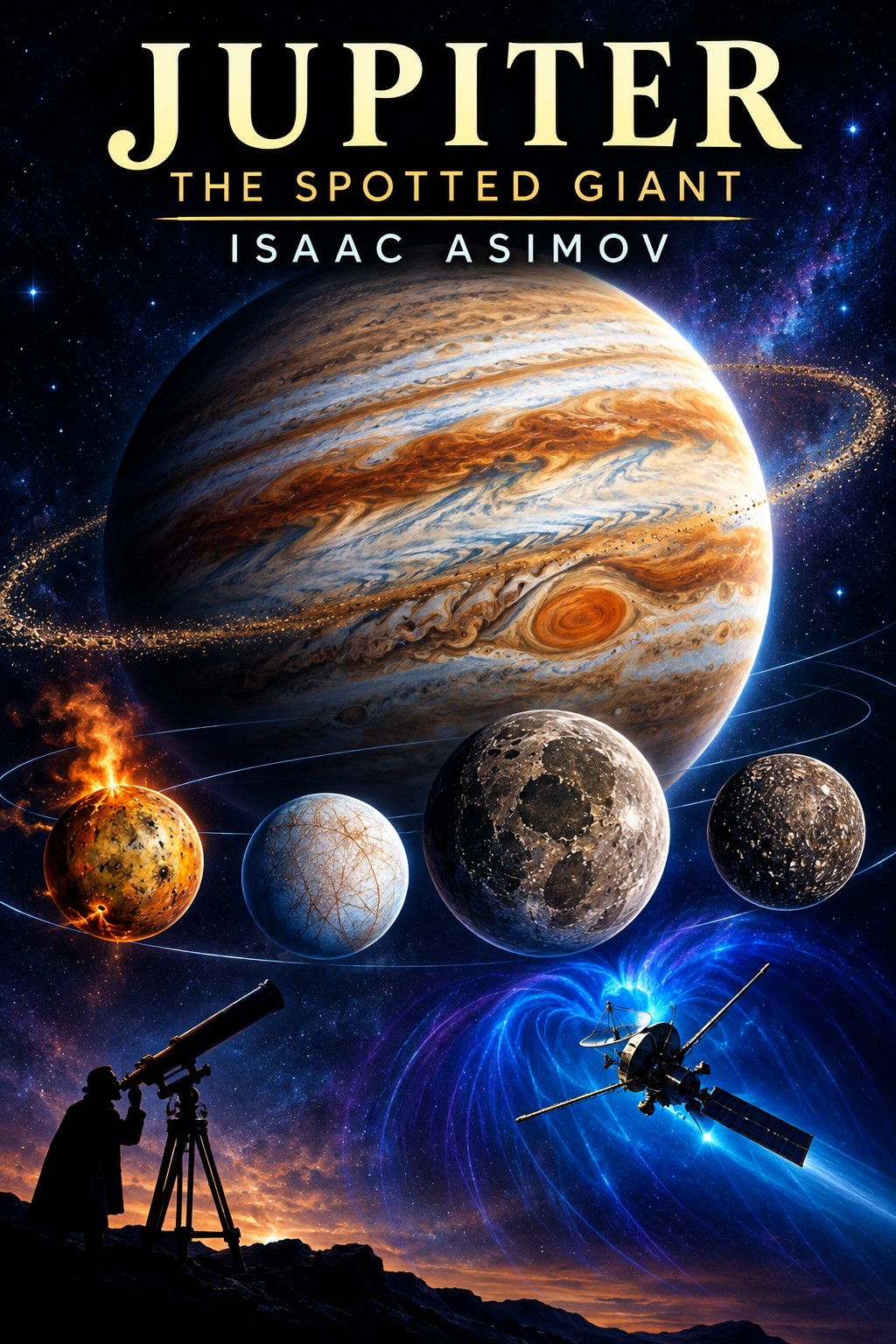
Isaac Asimov opens Jupiter: The Spotted Giant by introducing the immense scale of the Solar System's largest planet, a world more than eleven times wider than Earth and hundreds of times more massive. Rather than presenting a conventional solid sphere like Earth, the narrative frames Jupiter as a giant planetary system dominated by hydrogen and helium, featuring an atmosphere that grows progressively denser and stranger as one travels downward. This fundamental contradiction, an enormous world devoid of a traditional solid surface, establishes the central scientific mystery around which the entire work revolves. Deep within this environment, immense atmospheric pressure forces gaseous hydrogen into dense forms, eventually creating metallic hydrogen that conducts electricity and powers Jupiter's immensely strong magnetic field. The planet spins at an extraordinary speed, completing a full rotation in approximately ten hours, which drives powerful winds and shapes the atmosphere into broad, alternating cloud bands. Ultimately, the planet emerges not as a static ball in space, but as a vast, constantly moving atmospheric machine whose sheer scale and physics set it apart from smaller rocky worlds.
The narrative journey begins historically with the chapter "Galileo and Jupiter," tracing how humanity's perception of the planet was permanently transformed in 1610. For thousands of years prior, Jupiter appeared merely as a bright wandering point of light to the naked eye in the night sky. Everything shifted when Galileo Galilei aimed his newly improved telescope toward the heavens and observed four tiny points of light that changed positions from night to night. Galileo realized these points were moons orbiting Jupiter, providing clear physical evidence that not all heavenly bodies revolve around Earth. This groundbreaking discovery provided a crucial foundation for transforming humanity's understanding of the Solar System by offering a visible, working model of orbital motion around another world. These four primary satellites, Io, Europa, Ganymede, and Callisto, would forever be remembered as the Galilean satellites, marking the initial spark of modern observational astronomy.
Building upon this historical foundation, the chapter "Looking at Jupiter" transitions to the practical experience of viewing the planet through telescopes. When observed from Earth, Jupiter stands out because even a modest telescope reveals a distinct disk rather than a simple point of light. Dark and light bands stretch dramatically across its visible disk, while its four major moons appear nearby like tiny celestial companions. As these moons continuously shift positions, they offer astronomers a natural, miniature laboratory in space for studying orbital mechanics. Earthbound observers can track Jupiter's rapid rotation, monitor changing atmospheric markings, and analyze the orbital paths of its satellites to deduce the underlying structure of the Jovian system. Through these methods, Jupiter becomes an accessible focal point for understanding celestial physics directly from our home planet.
In "What Kind of Planet Is Jupiter?" Asimov explores the extraordinary physical composition that sets this gas giant apart. Composed overwhelmingly of hydrogen and helium, Jupiter shares its fundamental chemical makeup with the Sun itself. However, because Jupiter lacks the immense mass required to trigger internal nuclear fusion reactions, it remains a giant planet rather than a burning star. As one descends into the atmosphere, the immense pressure forces gaseous hydrogen to transition into increasingly dense states. Beneath these immense atmospheric layers lies a dense interior containing heavier elements, though its precise interior structure remains a subject of ongoing scientific investigation. This rapid rotation and internal thermodynamic activity power an active weather system that shapes the visible face of the planet.
The narrative delves deeper into atmospheric dynamics within "The Planet of Swirling Storms," where Jupiter's extreme weather patterns are brought into sharp focus. The planet's rapid ten hour rotation organizes its atmosphere into immense currents and broad alternating cloud bands. The most famous feature within this violent atmosphere is the Great Red Spot, a gigantic reddish oval storm that has persisted for centuries. Unlike weather events on Earth, which are temporary and interrupted by solid landmasses, oceans, mountains, and seasonal variations, Jupiter possesses no solid surface to break up atmospheric motion. As a consequence, immense storms like the Great Red Spot can interact, endure, and grow over centuries on scales almost unimaginable from an Earthbound perspective. Expanding this structural picture, "Jupiter's Rings" unveils a dark, thin ring system made of fine dust particles generated by impacts on surrounding moons, connecting the central planet dynamically to its satellites.
Moving outward into "Jupiter's Family," the focus expands to the diverse array of moons that orbit the gas giant. While Jupiter is surrounded by a large collection of satellites, four major worlds dominate the story. The first of these examined in detail is "Callisto: The Distant Moon," which orbits as the outermost of the Galilean satellites. Callisto displays an ancient, heavily cratered surface, preserving an ancient record of early Solar System collisions as a quiet, inactive world. The narrative next highlights "Ganymede: The Moon Bigger Than Mercury," focusing on the largest satellite in the Solar System. Ganymede is so vast that its physical diameter exceeds that of the planet Mercury, proving that strict boundaries between moons and planets can be misleading when evaluating size alone. This massive satellite exhibits a complex geological history marked by varied surface terrain and possesses its own intrinsic magnetic field.
The story takes a dramatic turn in "Europa: The Icy Moon," introducing one of the most scientifically tantalizing worlds in planetary science. Europa's bright exterior is encrusted in ice and crisscrossed by long fractures, beneath which scientific evidence suggests the existence of a vast, subsurface ocean of liquid water. Gravitational interactions between Europa, Jupiter, and the other Galilean moons generate internal tidal heating, providing the energy needed to keep water liquid beneath the frozen crust and making Europa a prime target in the search for potential life. The final member of the four major satellites is introduced in "Io: The Volcanic Moon," presenting a stark contrast of violence and activity. Positioned closest to Jupiter, Io suffers immense gravitational squeezing and tidal stress from the massive planet. These extreme gravitational forces heat Io's interior, triggering intense and continuous volcanic eruptions that make it one of the most geologically active worlds in the Solar System. Together, Callisto's ancient scars, Ganymede's massive complexity, Europa's icy ocean, and Io's fiery volcanism demonstrate how four worlds orbiting the exact same planet can evolve along radically different paths.
In "What the Space Probes Have Told Us" and "Approaching Jupiter," the narrative transitions from Earthbound telescope views to modern robotic exploration. Space missions such as Pioneer and Voyager revolutionized planetary science by traveling directly to Jupiter, capturing close up photographs of its atmosphere and moons, discovering its faint rings, and measuring its intense radiation and magnetic environment. Later, the Galileo spacecraft expanded this exploration by entering orbit around Jupiter to conduct long term studies of the Jovian system. Approaching Jupiter presents a monumental engineering challenge, as spacecraft must navigate a harsh gravitational and radiation field filled with dynamic moons and powerful magnetic forces. The narrative closes its descriptive tour with "What Jupiter Looks Like," connecting close up spacecraft findings back to the visible planet seen from Earth. The familiar atmospheric stripes, belts, zones, and Great Red Spot observed through telescopes are recognized not as surface decorations, but as the visible upper boundary of an immensely deep fluid world in continuous motion.
In evaluating Jupiter: The Spotted Giant, it is evident that there are no fictional mini stories; instead, Asimov constructs a continuous scientific narrative that builds logically from historical observations to modern space probes. His narrative arc begins with Galileo's initial telescopic observations, progresses through physical theories about Jupiter's internal structure and atmosphere, expands into its dark rings and four distinct moons, and culminates in robotic exploration. Asimov masterfully transforms factual data into a series of interconnected scientific questions: why does such a massive planet rotate so quickly, what creates its bands and enormous storms, why do moons orbiting the same planet look so vastly different, and how can an icy world conceal a liquid ocean? Each answered question uncovers deeper mysteries, illustrating that scientific discovery is an ongoing, logical progression.
Ultimately, Asimov's work serves as a compelling review of how human knowledge evolves over time. By framing facts as clues within a grand story of planetary evolution, Asimov demonstrates that a single planet can act as a vast physical laboratory for physics, atmospheric dynamics, and geology. What begins as four faint points of light in Galileo's primitive telescope expands through centuries of investigation into a complex world of metallic hydrogen, violent storms, faint rings, and diverse moons ranging from fiery volcanoes to subterranean oceans. Asimov leaves the reader with a profound appreciation for scientific inquiry, showing that as tools advance and humanity probes deeper into space, the universe reveals itself to be far stranger, more intricate, and more beautiful than initial observations ever suggested.