The Hugo Winners, Volume V
This anthology maps science fiction’s evolution toward psychology, testing human wisdom and identity within diverse futures governed by coherent logic.
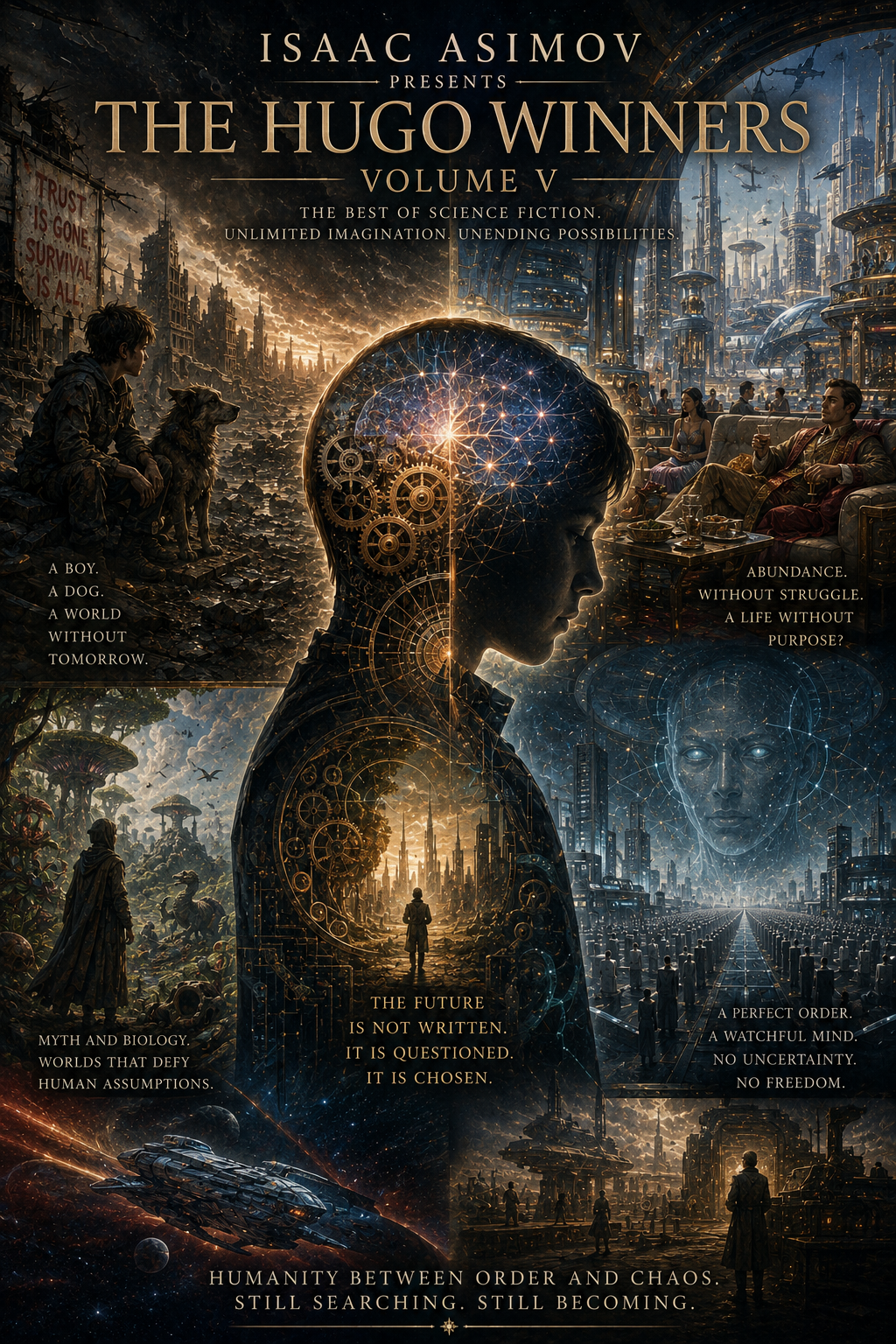
There was a time when science fiction was a simpler endeavor. It was a literature of the gadget, where the primary thrill came from a new invention or a voyage to a nearby moon. But as the years passed, the genre grew restless. It began to look inward, not just at the gears of a machine, but at the gears of the human mind and the structures of the societies we build. The Hugo Winners, Volume V represents a crucial point in this journey. It is not merely a collection of popular tales; it is a map of a genre that has reached a new level of sophistication. The stories gathered here show that while the excitement of invention remained, it was no longer enough by itself. The future had become a complicated place, concerned with psychology, philosophy, and the heavy weight of social systems.
In looking back at these selections, one can see a deliberate arrangement of ideas. The anthology functions like a mosaic, balancing the grand scale of civilizations with the intimate struggles of individuals. It reflects a moment when the early optimism of technological conquest matured into an investigation of the human condition under altered circumstances. We see a transition from exploring the external world of rockets and planets to exploring the internal landscapes of identity, morality, and freedom. Each story acts as a systematic exploration of a single possibility and its consequences. Even when the visions are dark, there is a persistent belief that inquiry is valuable and that the human mind must remain active and questioning.
The first of these explorations is found in The Sharing of Flesh by Poul Anderson. It addresses the fundamental need for humanity to adapt when encountering alien conditions that defy simple courage or technological solutions. It suggests that survival in a vast universe depends on a willingness to transform and to abandon old, rigid assumptions. The logic of the narrative is steady and clear, as every strange environmental condition produces a consequence, and those consequences must inevitably reshape human behavior.
The tone shifts significantly with Riders of the Purple Wage by Philip José Farmer, which moves into the realm of satire. It examines a civilization where material abundance is guaranteed and needs are met automatically. Rather than creating a utopia, this state of plenty leads to a world that is both liberated and stagnant. It poses a rigorous question about what happens to the human spirit when the central struggle for survival is removed, treating economics and culture with the same precision one might apply to physics.
In Ill Met in Lankhmar by Fritz Leiber, the anthology acknowledges that the logic of a world is more important than whether it is strictly scientific or fantastical. The narrative focuses on the inevitable meeting of two individuals who are destined for legendary status, set within a city that functions as a living, dangerous system. It highlights a common concern across all speculative fiction, which is the exploration of environments governed by their own coherent, internal rules.
A harsher perspective emerges in A Boy and His Dog by Harlan Ellison. In this vision, civilization has fractured into a brutal landscape where social order has vanished. The focus shifts to an intimate and savage relationship where intelligence and companionship are the only remaining anchors. It reflects a turn in the genre where the future is no longer assumed to be a path of steady progress, but a place where we must examine what remains of us when everything else is stripped away.
A more meditative approach is found in Slow Sculpture by Theodore Sturgeon. This story argues that progress is not always a matter of grand, dramatic breakthroughs, but is often quiet, incremental, and deeply rooted in human relationships and patience. It demonstrates that science fiction can achieve significant emotional depth without losing its intellectual rigor, reminding the reader that the way we treat one another is as important as the things we build.
Experimental structure takes center stage in The Beast That Shouted Love at the Heart of the World by Harlan Ellison. The narrative is fragmented, reflecting a universe in a state of crisis. Despite its chaotic appearance, the core of the story is an attempt to understand the connections between different minds and worlds. It shows how the genre began to stretch its formal boundaries to match its conceptual ambitions.
The Queen of Air and Darkness by Poul Anderson is a story that bridges the gap between myth and reason. When faced with phenomena that appear supernatural on a distant world, the characters find that the explanation remains rooted in rational inquiry. It reinforces the idea that mystery is not the opposite of reason, but an invitation for it. This is followed by his story Goat Song, which presents a tragic view of a future governed by a vast artificial intelligence. In this world, suffering has been eliminated, but so has the unpredictability of genuine human experience. It suggests that technology might solve our practical problems while simultaneously creating a form of spiritual emptiness.
Ultimately, The Hugo Winners, Volume V does not offer a single conclusion about where humanity is headed. Instead, it offers many futures, each logically developed from a different starting point. Some of these paths are unsettling and some are hopeful, but all of them test our wisdom and our ability to remain human in a changing world. The anthology closes with the understanding that the questions raised by these stories are never truly resolved, as they belong to the ongoing journey of humanity itself.