Young Star Travelers
Young explorers journey through space using logic, discipline, and cooperation to navigate obstacles and unfamiliar worlds, gaining a mature and grounded perspective on their humanity.
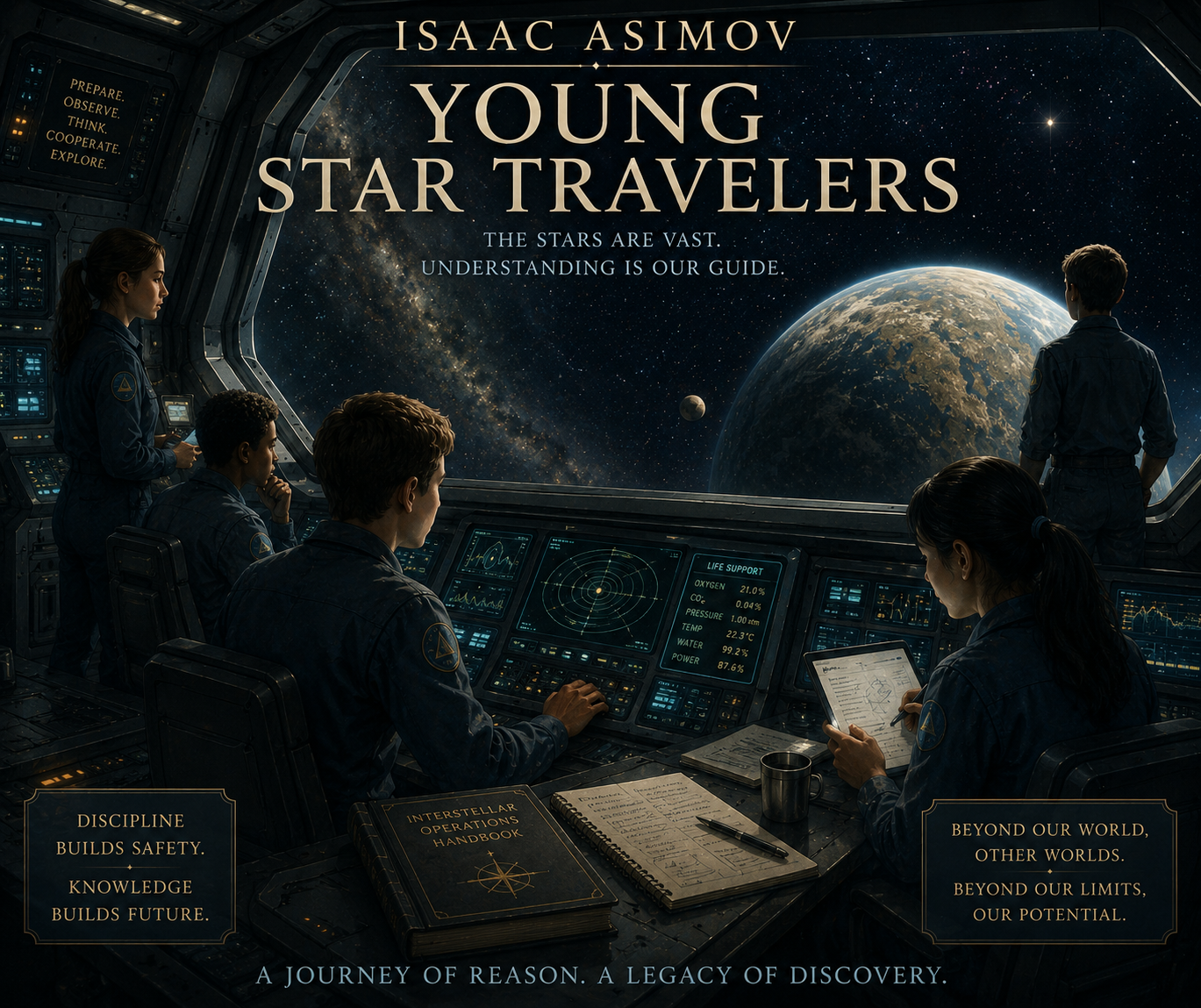
In the vast library of future histories, where the logic of the machine meets the curiosity of the human spirit, there exists a specific architecture of discovery. This structure is best viewed through the experiences of those who look at the stars not as distant points of light, but as destinations. In this particular account of exploration, the narrative unfolds with a steady, exploratory rhythm that is characteristic of a mind that values reason over spectacle. It is a story about the expanding human relationship with the vacuum of space, treating interstellar travel not as a flight of fantasy, but as the logical next step in a history of reaching further than the generation before.
The journey begins in The Dream of the Stars, where we find a civilization that has already stepped off its home world. Here, the reality of space travel is no longer an abstract dream found in old textbooks, but a practical, organized system. Yet, a fundamental divide exists within this society. To the adults who maintain the systems, the stars represent a heavy burden of responsibility, filled with known dangers and immense costs. To the younger generation, however, these same stars represent a world of possibility that has not yet been codified or limited by caution. This tension sets the stage for a journey where the primary conflict is not between people, but between the desire to know and the necessity of surviving the environment that governs such knowledge.
As the narrative moves into Training for Space, the focus shifts from the initial dream to the rigorous demands of preparation. It becomes clear that desire alone is insufficient for the traveler. Exploration requires a deep commitment to discipline, learning, and the often overlooked necessity of human cooperation. The systems of a spacecraft are not magical artifacts; they are mechanical and physical realities that must be understood in every detail. Every life support cycle and every navigation calculation is part of a coherent structure where air recycling and communication are as vital as the engines themselves. This phase of the story emphasizes that the future does not belong to the merely brave, but to those who possess the patience to understand the physical laws of their environment.
When the moment of departure arrives in The Voyage Begins, the narrative maintains a calm, procedural realism. There is no sudden miracle or melodramatic flourish to mark the ships exit from the influence of Earth. Instead, the weight of the journey is felt through the confirmation of instruments, the monitoring of checklists, and the steady verification of calculations. The stars are reached through the slow accumulation of correct decisions. Once the travelers are truly between worlds, as seen in Life Between Worlds, the psychological reality of the void begins to press inward. The ship becomes a miniature world where the vastness of the external silence magnifies every internal disagreement. In this isolation, intelligence is tested alongside emotional control and adaptability. The travelers learn that moving outward into the galaxy necessitates a parallel journey into the self, discovering how to maintain order and purpose when the familiar landmarks of home are gone.
The arrival at The Unknown Planet brings the explorers face to face with a world that refuses to conform to their preexisting expectations. This world is not hostile in a conventional sense; it is simply unfamiliar. The terrain and the biological systems do not bend to human convenience, requiring the travelers to practice a profound humility. They succeed not by overpowering the environment, but by studying it with careful observation before taking a single step. This reinforces the idea that the universe was not arranged for us, and we must be the ones to adapt through the application of reason.
This commitment to logic is tested further in The Test of Judgment, where the inevitable errors of human operation threaten the mission. Rather than turning into a frantic action sequence, the crisis is resolved through systematic thinking. The characters must test their assumptions and examine evidence to solve the problem, demonstrating that the way a mistake is addressed is more important than the mistake itself. This intellectual rigor continues in The Alien Encounter, where the possibility of nonhuman intelligence is explored. In keeping with a philosophy of understanding, the focus is not on conflict or defense, but on the difficult work of communication. The travelers find that their own human assumptions are unreliable when trying to interpret minds shaped by entirely different physical conditions. The challenge is not to defeat the unknown, but to find a common language with it.
As the mission concludes in The Return Journey, the narrative becomes reflective. The young travelers who come home are no longer the same people who left. They have been changed by the experience of the vast and demanding reality of space. They return with a grounded perspective on the fragility of life and a clearer understanding of the scale of the universe. The wonder they feel is no longer based on a dream, but on the solid foundation of knowledge.
Ultimately, this account serves as a testament to the idea that human progress occurs step by step, through curiosity that has been disciplined by reason. The style of the story is direct and clear, ensuring that the ideas remain the central focus without unnecessary ornamentation. It presents a future that is neither a perfect utopia nor a scene of catastrophe, but an unfinished work that requires the persistent effort of each new generation. The story does not end with a final victory, but with the quiet realization that beyond the completed mission, there are always more stars and more questions waiting for those willing to learn.