Norby Finds a Villain
Jeff and Norby investigate colony sabotage, revealing a villain manipulating fear. They restore trust through unique abilities and communication, proving perception is key.
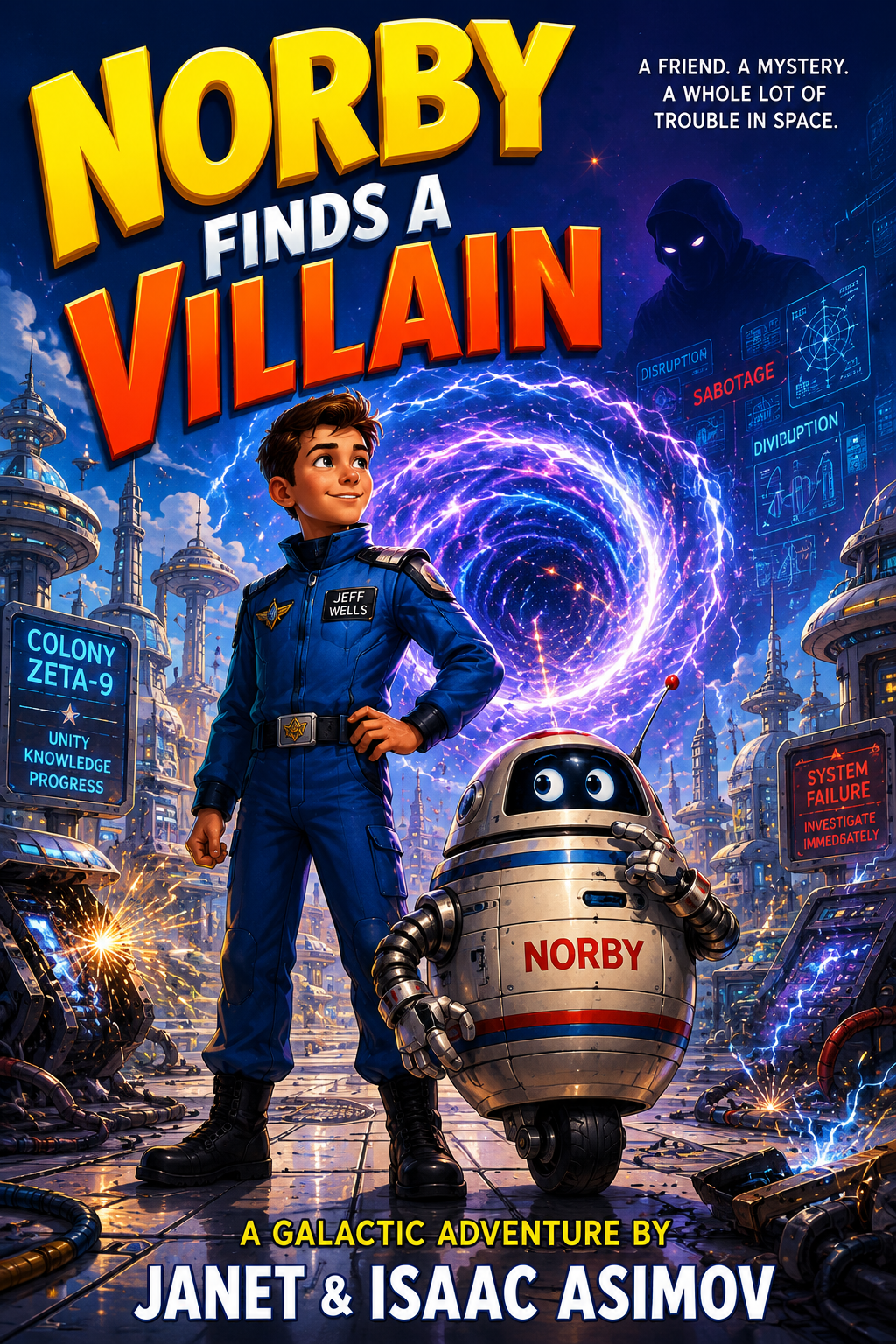
The Norby adventures have always occupied a delightful space between science fiction, fantasy, and humor. Unlike the solemn robots that populate Isaac Asimov's adult fiction, Norby is wonderfully unpredictable. He is an outdated educational robot who possesses impossible abilities that no scientist can explain and no engineer can reproduce. His anti gravity field, accidental teleportation, and mysterious extra dimensional nature constantly create situations where logic and chaos travel hand in hand. In Norby Finds a Villain, the familiar ingredients return, but this time the story explores one of the oldest themes in adventure fiction: the search for a true villain and the surprising discovery that appearances are often deceptive.
The novel begins with Norby and his young owner and friend, Jeff Wells, enjoying what appears to be an ordinary assignment aboard the starship Searcher. Jeff is older and more confident than in the earliest adventures, but he still finds himself following Norby into situations that no sensible cadet would willingly enter. Admiral Yobo expects routine investigations and diplomatic missions, yet everyone has learned that where Norby goes, extraordinary events inevitably follow. The adventure begins when reports emerge from a distant colony describing mysterious acts of sabotage. Equipment disappears without explanation, communication systems fail at critical moments, and valuable scientific research is stolen almost as soon as it is completed. The pattern suggests the work of a brilliant criminal, someone who always stays one step ahead of the authorities.
Jeff naturally assumes that the solution will come through careful investigation, while Norby approaches the mystery with his usual innocent curiosity. Rather than searching for clues in the conventional manner, Norby asks unusual questions, befriends unlikely individuals, and follows instincts that seem completely irrational. The contrast between Jeff's logical thinking and Norby's unpredictable methods creates much of the novel's humor. As they arrive on the troubled world, they discover a colony filled with suspicion. Scientists distrust politicians, merchants blame engineers, security officers accuse outsiders, and every unexplained event increases fear among the population. The mysterious villain has accomplished more than theft; he has succeeded in making everyone doubt everyone else.
Jeff attempts to organize evidence into orderly categories, but Norby notices details that humans ignore. He pays attention to frightened children, neglected robots, forgotten corridors, and casual conversations that appear meaningless. His extraordinary perception gradually reveals that the obvious suspects are merely victims of carefully constructed misunderstandings. The search introduces a colorful collection of characters typical of the Norby series. There are ambitious officials determined to protect their reputations, absent minded scientists who become absorbed in theories while disasters unfold around them, loyal technicians who quietly keep civilization functioning, and children whose straightforward observations often prove more valuable than adult expertise. Each contributes another piece to the puzzle while providing moments of gentle comedy.
The mystery grows deeper when impossible events begin occurring around Norby himself. Doors open without commands, hidden chambers appear where solid walls should exist, and forgotten machines suddenly come to life. Because Norby's own origins remain mysterious, he seems strangely connected to the unknown force manipulating events. Even Jeff briefly wonders whether his friend is somehow attracting trouble rather than solving it. As in many Norby adventures, travel extends beyond ordinary space. Norby's unique abilities accidentally transport the group through dimensions that conventional science cannot explain. Strange landscapes appear where physical laws behave differently, and time itself seems flexible rather than fixed. These journeys are not presented as frightening but as opportunities for exploration and discovery, reflecting the optimism that characterizes the entire series.
Eventually Jeff and Norby uncover the truth behind the supposed super criminal. The villain is indeed intelligent, but not in the traditional sense of an evil mastermind seeking wealth or conquest. Instead, the antagonist has manipulated misunderstandings, fear, and prejudice, allowing ordinary people to create their own conflicts while remaining almost invisible. This revelation transforms the story from a simple detective adventure into a lesson about perception. The greatest danger is not advanced technology or superior weapons but the willingness of people to accept suspicion without evidence. The colony nearly destroys itself because individuals stop communicating honestly with one another.
Norby's solution reflects his own personality. Rather than defeating the villain through force, he creates opportunities for people to see one another differently. His unpredictable actions expose hidden truths, restore trust, and reveal connections that had been overlooked. The climax combines excitement with humor, as carefully constructed criminal plans collapse because Norby refuses to behave according to anyone's expectations. The resolution emphasizes reconciliation instead of punishment. Characters who distrusted each other begin working together, scientists share discoveries instead of guarding them, and children once again view robots as companions rather than suspicious machines. Even the villain becomes more understandable than monstrous, reinforcing the book's belief that ignorance and fear often create problems that appear to be deliberate evil.
Throughout the novel, Norby himself remains the heart of the story. He is endlessly curious, unfailingly optimistic, and incapable of accepting the cynical assumptions that adults often consider practical. His greatest strength is not his mysterious powers but his willingness to believe that every individual deserves another chance. This quality repeatedly allows him to solve problems that intelligence alone cannot overcome. The partnership between Jeff and Norby also continues to mature. Jeff provides discipline, education, and responsibility, while Norby contributes imagination, empathy, and spontaneity. Together they represent the balance between logic and creativity, a partnership that echoes many of Isaac Asimov's favorite themes: reason should guide humanity, but reason becomes far more effective when joined with curiosity and compassion.
Reading Norby Finds a Villain feels like accompanying two old friends on another unpredictable expedition across the galaxy. Every chapter introduces new mysteries, amusing misunderstandings, and imaginative scientific ideas presented with lighthearted charm. The danger is real enough to maintain suspense, yet the atmosphere never loses its sense of wonder. In the end, the novel quietly suggests that villains are rarely as simple as stories make them appear. Sometimes the greatest enemy is fear, isolation, or misunderstanding, while friendship and open communication become the most powerful tools for restoring order. Wrapped inside an entertaining adventure full of teleportation mishaps, eccentric robots, and cosmic mysteries is a gentle reminder that wisdom often comes from looking beyond appearances. Like the best Norby stories, it leaves the reader smiling, thinking, and eager to accompany the little robot on his next impossible adventure.