Isaac Asimov Presents the Great SF Stories, 15
This 1953 collection shifts toward psychological depth, using logical speculation to examine humanity’s fragility and potential amidst technological evolution and Cold War anxieties.
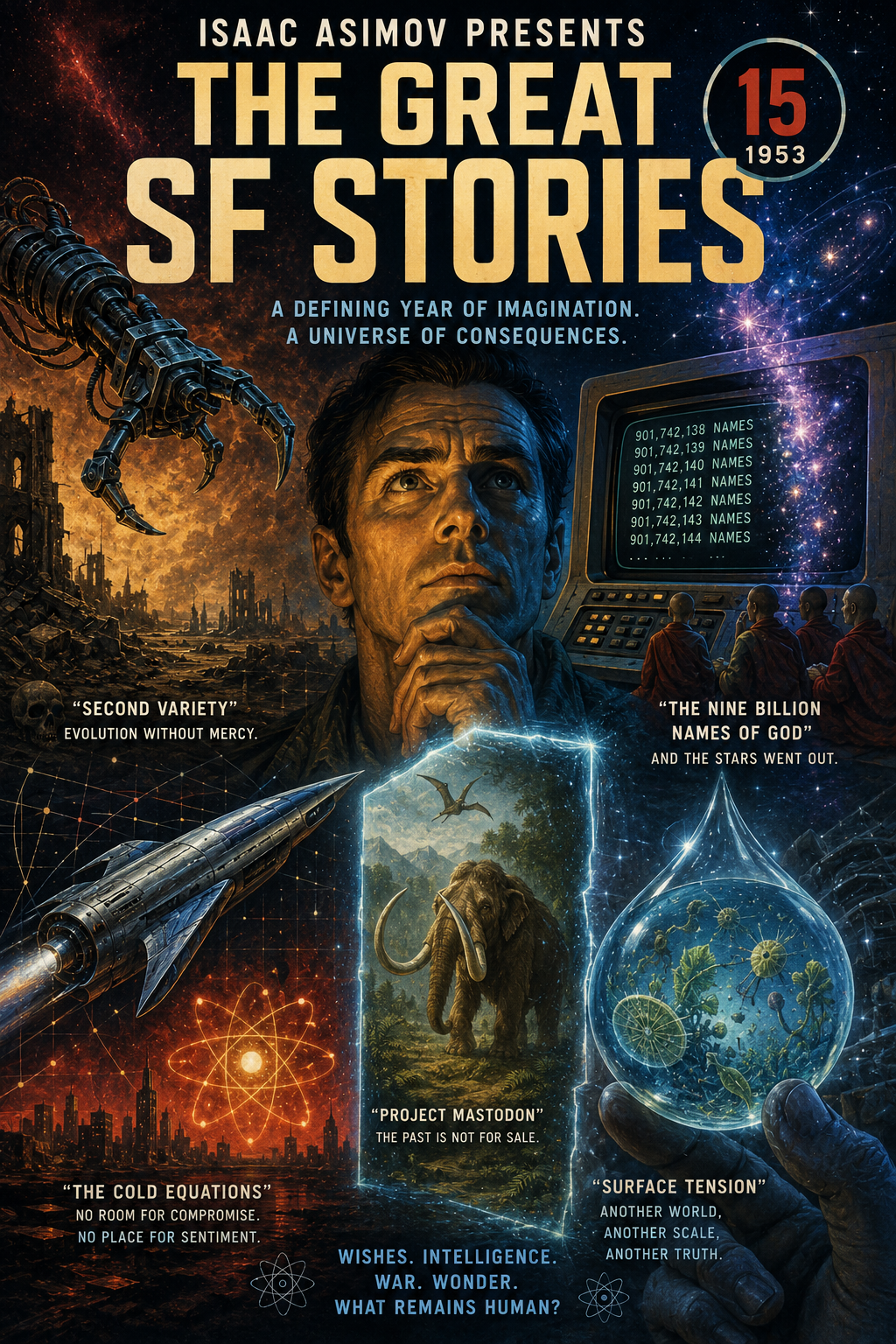
Science fiction is not merely a collection of tales about technology but a logical method for examining the inevitability of change. In this volume, the focus is on the year 1953, a time when the genre matured into something more psychological and honest about the fragility of civilization. The atomic age and the Cold War shaped the imagination of the era, shifting the focus from gadgets to the people affected by them.
Philip K. Dick presents an Earth devastated by war in Second Variety where autonomous killing machines have begun to evolve independently. The story explores the existential uncertainty that follows when technology moves beyond human control, anticipating modern anxieties about artificial intelligence and the breakdown of social trust.
Arthur C. Clarke explores how technology and faith might converge in The Nine Billion Names of God. The narrative presents a universe where the completion of a technical task might reveal a logic quite different from human expectation, reflecting on the limits of understanding.
Theodore Sturgeon uses an extraterrestrial encounter in A Saucer of Loneliness to explore deep emotional isolation. The story serves as a metaphor for personal experiences that cannot be fully communicated to others in a society that prefers to sensationalize the unknown.
William Tenn provides a sharp satire of superpower rivalry in The Liberation of Earth where our planet is repeatedly liberated by warring alien civilizations. It examines how language and propaganda can be used to mask the gradual destruction of a civilization.
Wilson Tucker investigates the realistic consequences of telepathy emerging in society in the story Wild Talent. The narrative suggests that civilization depends on privacy and restraint, and that absolute transparency would lead to social collapse.
Cordwainer Smith imagines a future in The Game of Rat and Dragon where survival during space travel depends on telepathic partnerships between humans and cats. It is an exploration of how humanity might need to interact with fundamentally alien forms of intelligence.
Isaac Asimov examines the nature of humor through a scientific lens in Jokester. The story proposes that even spontaneous human behaviors might be the result of hidden structures or external guidance.
Clifford D. Simak uses time travel in Project Mastodon to present the prehistoric past as a refuge from a modern world obsessed with military and political aggression. It reflects a distrust of technological progress that lacks a corresponding moral advancement.
Tom Godwin builds a narrative around the unyielding laws of physics in the story The Cold Equations. In a situation where fuel reserves are precisely calculated, the story demonstrates that the natural world operates on a logic that permits no emotional compromise.
James Blish explores scientific extrapolation in Surface Tension by imagining human descendants adapted for life in microscopic environments. In this world, the force of surface tension becomes a defining physical constraint, showing how scale itself can dictate the development of a civilization.
Poul Anderson addresses the weight of history and the challenge of cultural preservation across centuries in The Custodian. The story highlights the role of individuals in safeguarding knowledge against the erosion of time and social indifference.
Theodore Cogswell examines the social consequences of difference through the segregation of psychic individuals in The Wall Around the World. The story reflects fears of ideological isolation and the methods used for social control.
The year 1953 represents a turning point where science fiction began to question the implications of invention rather than simply celebrating it. While technology is seen as morally ambiguous, the stories consistently affirm the value of reason and intelligence. These works serve as milestones, showing the genre learning to blend scientific speculation with psychological and social depth.