Far as Human Eye Could See
Asimov’s essays trace scientific discovery from ordinary everyday objects to the vast cosmos, proving how reason and technology extend human vision.
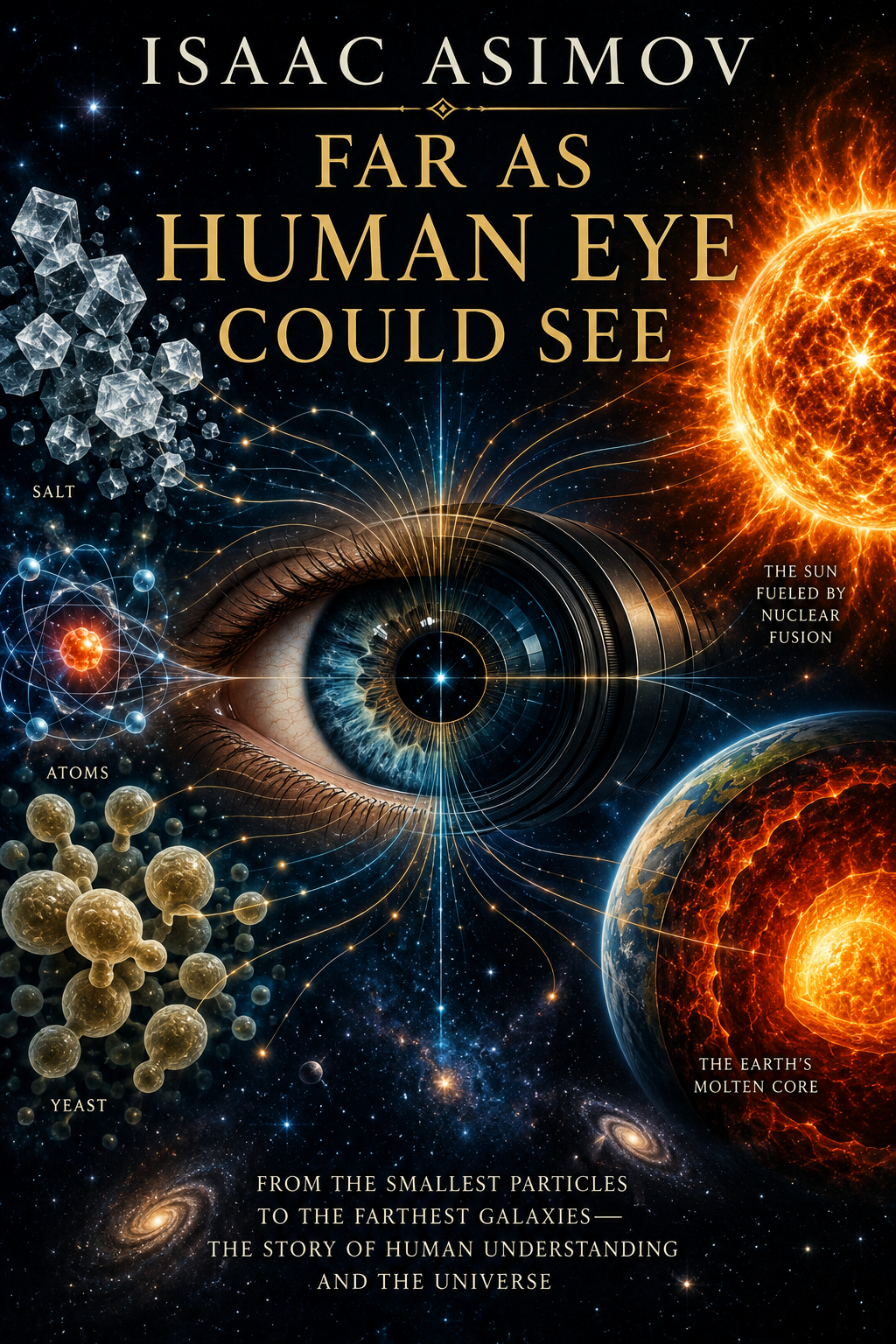
To understand the works of Isaac Asimov is to understand a mind that viewed the universe as a vast, solvable puzzle. In the collection of seventeen essays titled Far as Human Eye Could See, originally penned for The Magazine of Fantasy and Science Fiction between 1984 and 1986, we find the Good Doctor at the height of his explanatory powers. This book does not offer a single fictional narrative like his Foundation series; instead, it presents a continuous story of human curiosity, tracing how we have moved from the familiar to the unfathomable,. The book is a late period masterpiece, published in 1987, that serves as a bridge between the simple observations of the human senses and the grand architecture of the cosmos,.
The story Asimov tells here is one of extension,. He begins with the premise that while our physical senses are limited, our reason is not. He argues that science is not merely a collection of cold facts, but a narrative of discovery where mistakes, experiments, and gradual enlightenment lead us to see further than nature ever intended. The book is divided into four movements physical chemistry, biochemistry, geochemistry, and astronomy each building upon the last to expand the reader’s horizon. Like all of Asimov's best non fiction, the logic is linear and relentless, starting with an ordinary object and ending with a universal truth,.
In the first chapter of this intellectual journey, Made, Not Found, Asimov explores the threshold where human ingenuity overtakes nature. He tells the story of how chemistry shifted from the simple discovery of existing materials to the deliberate manufacturing of new compounds. This is the story of humanity learning to rearrange atoms, transforming what once seemed like magic into a logical consequence of deep understanding. It sets the stage for everything that follows: the idea that we are no longer just observers of the world, but active participants in its creation.
The narrative then moves to Salt and Battery, where the humble salt shaker becomes a gateway to the history of portable power. Asimov explains the transition of salt into charged particles, showing how these simple chemical reactions became the foundation for modern batteries. This leads naturally into Current Affairs, where the focus shifts to the energy itself. He recounts the historical struggle to differentiate between static and flowing electricity, illustrating how the mastery of electrons transformed a mysterious spark into the lifeblood of modern civilization.
As we look closer at the world, we find that some structures are invisible. In Forcing the Lines, Asimov describes the discovery of magnetic and electric fields. He shows how scientists learned to visualize these hidden lines of force, eventually realizing that empty space possesses its own complex structure. This realization leads us upward in Arise, Fair Sun!, where the focus turns to solar energy. Asimov traces the evolution of our understanding of the Sun, from an ancient deity to a massive nuclear fusion reactor that powers almost every process on our planet.
The story then enters the realm of the living with Poison in the Negative, where Asimov reframes toxins not as evil substances, but as vital tools for biological understanding. By studying how poisons disrupt life, scientists learned how life itself functions at a molecular level. This theme of big things coming from small causes continues in Tracing the Traces, which examines the essential role of trace elements. He tells the story of the painstaking research required to find these microscopic necessities, proving that the most trivial substances can have enormous biological consequences.
In The Goblin Element, Asimov turns into a detective, recounting the search for a specific, puzzling chemical element that eluded scientists for generations. It serves as a reminder that science often moves forward by solving the mysteries hidden in the margins. From the chemical, he moves to the microbial in A Little Leaven, using yeast to explain the broader history of biochemistry and metabolism. He presents yeast as a symbol of life’s incredible power to transform matter through invisible, elegant processes.
Continuing the exploration of biological precision, The Biochemical Knife Blade examines enzymes. Asimov describes these molecules as exquisitely crafted tools capable of performing exact chemical tasks with astonishing efficiency, allowing for the complexity of life. Then, in the book’s lone geochemistry essay, Far, Far Below, he takes the reader beneath the Earth’s crust. Because we cannot travel to the core, he demonstrates how indirect reasoning and logic allowed humanity to map a region we can never see with our own eyes.
The final section of the book looks toward the heavens, beginning with Time Is Out of Joint. Asimov explains that time is not an absolute constant but a measurement that requires frequent adjustment as we discover irregularities in the Earth’s motion. This leads to The Discovery of the Void, where he explores the shocking realization that the vast majority of the universe is empty space. He traces the intellectual journey from the ancient belief in a filled heaven to the modern acceptance of the vacuum.
However, the vacuum is not truly empty, as explored in Chemistry of the Void. Asimov shows that even in the deepest space, there are atoms, radiation, and subtle interactions, proving that science always finds complexity where it once saw simplicity. This leads to a discussion of scale in The Rule of Numerous Small, where he explains how the collective behavior of countless tiny particles determines the fate of stars and galaxies. He then turns to the most dramatic of these celestial objects in Superstar, describing the birth, life, and death of the universe's largest and most luminous stars.
The collection reaches its climax in the title essay, Far as Human Eye Could See. This final chapter is a meditation on how technology has expanded the human reach. While the naked eye can only see a few thousand stars, our modern instruments allow us to look billions of years into the past and across trillions of miles of space. Asimov concludes that our vision grows outward and backward simultaneously; the farther we look into the distance, the deeper we look into the history of existence.
Reviewing the work as a whole, it is clear that Asimov’s true gift was not just in sharing information, but in crafting a narrative of human progress. He avoids jargon and complex equations, opting instead for a clear, logical presentation that makes the most difficult concepts accessible. The book is a celebration of the scientific enterprise the conviction that reason can always take us a little farther than our senses allow. It is a testament to Asimov’s lifelong faith in human curiosity and the idea that knowledge is a journey with an ever expanding horizon.