Magical Wishes
This anthology explores the dangerous consequences of human wishes, revealing that shortcuts to happiness often lead to unforeseen irony and require internal wisdom.
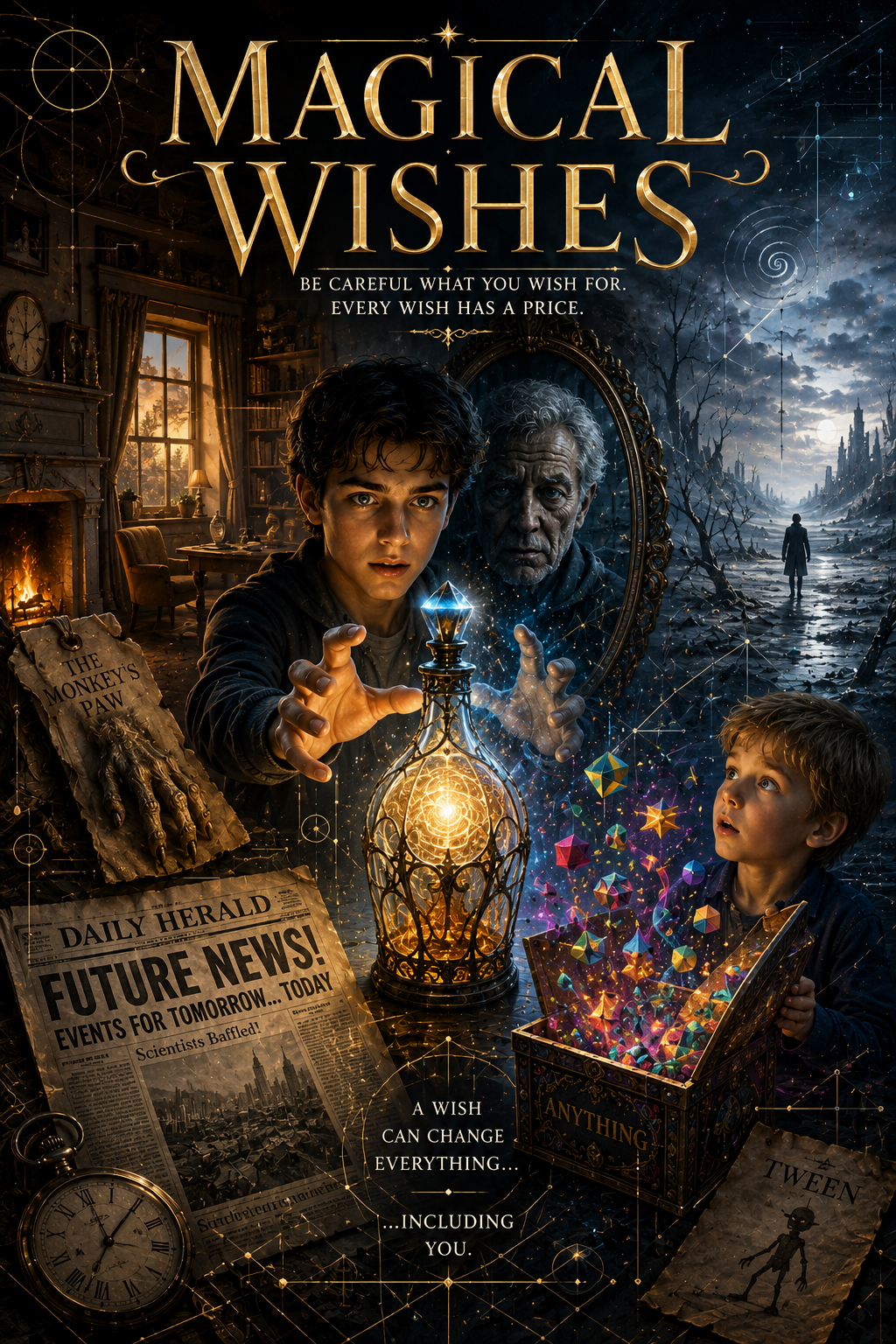
Consider the nature of a wish. Throughout history, human beings have searched for a shortcut around the hard realities of effort and suffering. We imagine that if we could simply change one thing about our world, we would finally find happiness. This anthology, titled Magical Wishes, is a collection of stories that examines this very impulse through a logical and often ironic lens. It is not merely a book of fairy tales, but a series of philosophical experiments designed to show that reality is a complex system where every action, no matter how miraculous, carries a consequence.
As we begin this exploration, we must understand that the anthology is built on a central truth: people rarely understand their own desires until they see them reflected in the cold light of fulfillment. Each story starts from a point of human longing, whether for wealth, love, certainty, or escape, and leads toward a revelation of how that longing affects the human spirit. The supernatural elements within these pages serve as a lens to examine ordinary behavior, following the Asimovian tradition of prioritizing Logic and the unforeseen effects of human decisions.
The journey through this collection starts with a foundational lesson in The Monkey's Paw by W. W. Jacobs. It introduces a family who receives an enchanted object from India capable of granting three wishes. The story builds from a modest desire for financial security, but it serves as a warning that fate should not be tampered with. It leads the reader into the depths of desperation, illustrating that wishes do not create happiness but rather expose the vulnerabilities and grief of the wisher.
Moving from horror to the subtle world of Behind the News by Jack Finney, we find a story that builds from a longing for certainty. An editor discovers that the future is leaking into the present through his newspaper. The story leads to a profound realization about human agency: if the future is entirely known, the freedom to choose becomes a meaningless illusion. It suggests that the uncertainty we often wish to escape is actually the foundation of our liberty.
In The Flight of the Umbrella, Marvin Kaye takes us toward the whimsical. An ordinary object becomes a vessel for impossible adventures, building from the simple wish to escape the mundane. However, it leads to a deeper theme regarding the addictive nature of fantasy. It highlights the temptation to live permanently within an illusion, preferring wonder over the reality of daily life.
The collection then shifts toward the technological and speculative with J. F. Bone’s Tween. Here, a mysterious being with the power to reshape reality interprets human desires with a terrifying literalness. The story builds from the dream of unlimited power but leads to a scene of chaos, demonstrating that precision in our language and understanding is more important than the passion of our wishes.
In The Boy Who Brought Love, Edward D. Hoch focuses on a more universal human desire: the wish for affection and belonging. The story builds from the cold environment of a cynical town visited by a boy with a unique gift. It leads toward a gentle suggestion that when Cynicism softens and lonely people reconnect, we witness the rarest miracle of all.
Ray Bradbury’s The Vacation builds from a desire many of us have felt: the wish for complete peace and the absence of the crowd. A couple finds themselves alone on Earth, but the story leads away from the initial joy of solitude toward the unbearable weight of isolation. Bradbury illustrates that our identity is more deeply tied to the presence of others than we often care to admit.
Zenna Henderson introduces a child’s perspective in The Anything Box. The story builds from the delightful image of a box that can produce anything imagined. Yet, it leads to a meditation on responsibility, showing that unlimited creation without the guidance of wisdom and maturity is a threat to the stability of reality itself.
In A Born Charmer by Edward P. Hughes, we examine the wish to be universally loved and influential. The protagonist possesses Charisma as a kind of wish granting ability that opens every door. However, the story leads to the discovery that effortless admiration is hollow. It dismantles the fantasy of charisma by showing that it can never replace genuine, earned human connection.
Isaac Asimov’s own contribution, What If..., approaches the concept of wishing through the lens of alternate possibilities. It builds from the intellectual curiosity about how small, trivial choices can change the entire course of a life. It leads to the logical conclusion that there are no perfect outcomes; every alteration of reality involves a complex balance of gains and losses.
Fredric Brown’s Millennium builds from the intersection of wishes with time travel and Paradox. It leads the reader through the complexities of interference, suggesting that Causality itself resists being manipulated for personal benefit.
In Dreams Are Sacred, Peter Phillips explores the wish for fame through the imagination. It builds from a world where dreams have become commercially valuable, but it leads to a critique of how the commercialization of creativity can corrupt the authenticity of art itself.
Robert Sheckley provides a satirical look at human nature in The Same to You Doubled. The story builds from a magical formula that reflects wishes back onto others with exaggerated force. It leads to an absurd collapse of civilization, exposing how frequently and carelessly people wish harm or inconvenience upon those around them.
Gordon R. Dickson’s Gifts examines the wish for supernatural abilities. It builds from the initial miracle of these powers but leads to a study of social isolation. It suggests that being different, even in a way that others envy, often creates a barrier between the individual and the community.
Bill Pronzini takes us back to psychological horror in I Wish I May, I Wish I Might. Building from a childhood rhyme, the story leads to a dark exploration of how wishes can become traps that reveal our hidden obsessions and guilt.
In Three Day Magic, Charlotte Armstrong presents a scenario where ordinary people are granted temporary magical power. The story builds from the initial excitement of this power but leads to a realistic portrayal of the slow erosion of morality. It shows that magic does not necessarily make people monsters; rather, it accelerates the flaws and selfishness already present within them.
Finally, the anthology concludes with The Bottle Imp by Robert Louis Stevenson, a masterpiece of moral fantasy. It builds from a bottle that can grant any desire, but it carries a terrible condition of eternal damnation if owned at the time of death. The story leads to the ultimate realization shared by the entire collection: wishes are never free.
As a reviewer, I must say that this anthology succeeds because it treats these fantasies with the seriousness they deserve. Each tale is a logical exploration of human nature, challenging the assumption that happiness can be granted externally. The collection reflects a fascination with irony and the unforeseen, suggesting that the greatest fantasy of all is the belief that one can achieve fulfillment without the hard work of developing internal wisdom. It is a clear and logical reminder that we should be very careful what we wish for, because we just might get it, along with everything else it brings.