Norby and the Queen's Necklace
Jeff and Norby travel to 1785 Paris via an alien necklace, accidentally altering history and forcing them to restore the timeline to save their future.
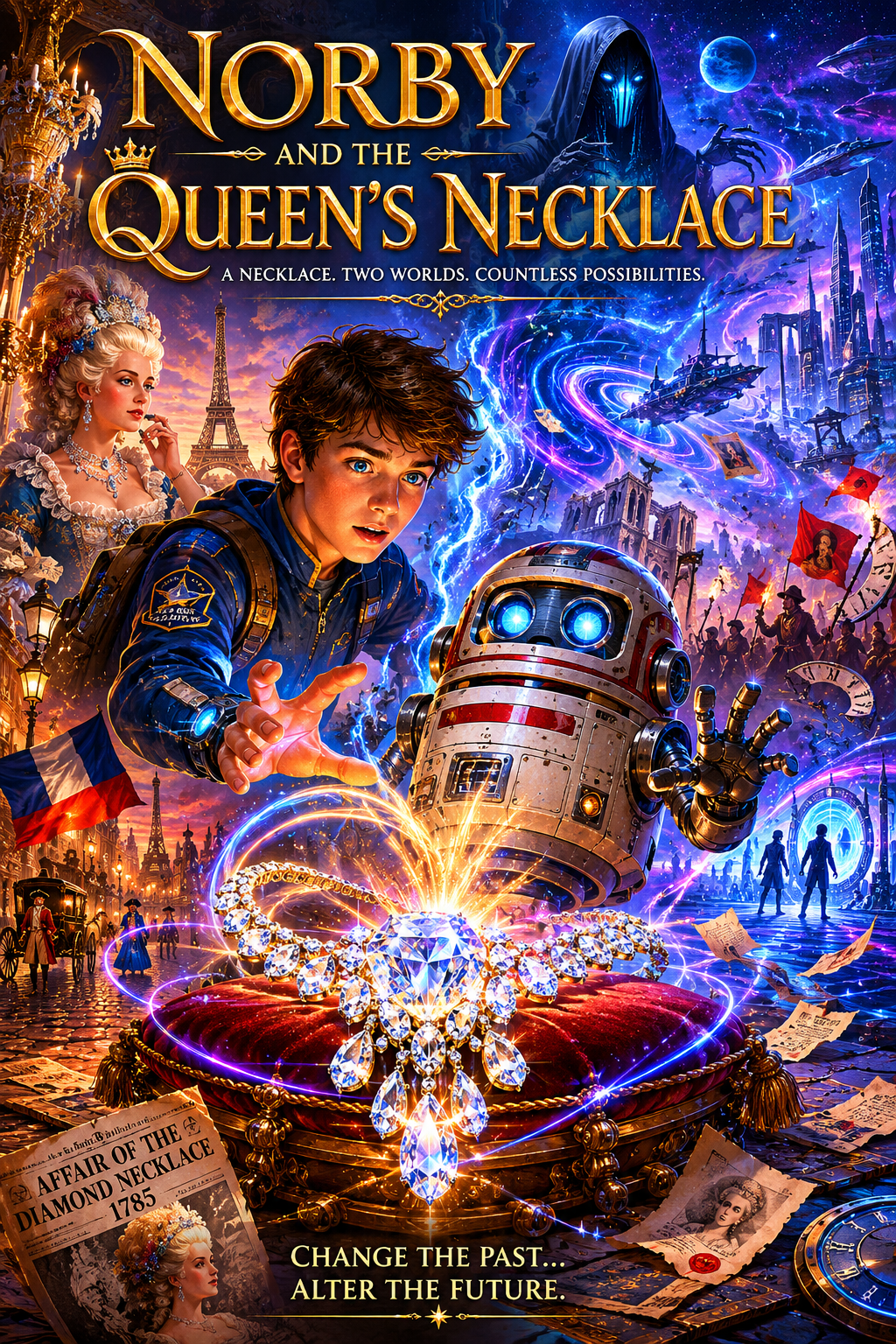
In the vast library of science fiction, there is a particular joy in a story that takes a simple premise and follows its logic to the very edge of the universe. When my wife Janet and I embarked on the adventures of a small, barrel shaped robot named Norby and his human companion, Jeff Wells, we wanted to explore the wonders of the cosmos through a lens of curiosity and friendship. In the volume known as Norby and the Queen’s Necklace, we found ourselves exploring not just the reaches of space, but the intricate and often fragile tapestry of time travel itself. The story begins in a place of learning, which is where all good adventures should start. Jeff Wells, a cadet at the Space Academy, is preparing for a historical recreation regarding the French Revolution, specifically the scandal of the diamond necklace that once belonged to Marie Antoinette. Norby, ever the helpful if occasionally confused companion, assists the students in mastering the French language for their performance. However, in a universe where the ancient and mysterious beings known as the Others have left their mark, a simple prop is rarely just a prop. The necklace they use is a replica, or so it seems, until it is fastened and the very fabric of reality begins to warp.
The School Performance
The story opens in a comparatively ordinary setting where the characters are grounded in their daily lives. Jeff Wells, now a capable young Space Academy cadet, is participating in a historical presentation along with his friends Fargo and Albany. Their museum intends to recreate scenes connected with Marie Antoinette and the famous necklace scandal. Norby, never content merely to observe, has even helped everyone learn authentic French for the performance. Everything appears harmless and the audience expects education and entertainment. Yet in the Norby universe, ordinary objects often conceal extraordinary secrets. The moment the necklace is fastened, reality bends. Without warning, Jeff and his companions find themselves no longer acting out history. They have become part of it.
Paris, 1785
The travelers arrive in Paris during the reign of Louis XVI and Marie Antoinette. Newspapers and local surroundings quickly establish that they have traveled to the year 1785, precisely during the period when the real diamond necklace scandal was unfolding. At first the travelers are stunned and practical concerns emerge about how they can return home and avoid attracting attention. Most importantly, they wonder how they can prevent themselves from accidentally altering history. Unfortunately, the last objective becomes impossible almost immediately. The necklace itself possesses powers far beyond ordinary technology and appears connected to the mysterious Others, advanced beings whose influence stretches throughout the series. What seemed to be a historical replica is actually a device capable of manipulating time.
Marcel and Revolutionary France
During their adventures Jeff and Fargo encounter a young Frenchman named Marcel. He becomes one of the story’s most engaging characters because he represents the ordinary citizen caught within extraordinary events. Marcel views the future travelers with amazement and skepticism because their explanations sound impossible. Yet circumstances repeatedly force him to confront realities beyond eighteenth century understanding. Through Marcel’s eyes, readers see revolutionary France not as a collection of historical facts but as a living world filled with uncertainty. The monarchy still stands and the revolution has not yet erupted. However, the presence of time travelers ensures that history will not proceed exactly as expected.
The Necklace Changes History
The central crisis emerges when the real necklace is removed from its historical path. The famous scandal never develops properly and the chain of political consequences that helped discredit the French monarchy begins to unravel. At first this seems insignificant, but history is not built solely from great battles and famous rulers. Small events influence public opinion, which in turn influences institutions and civilizations. The disappearance of the necklace produces a new timeline. When Jeff and Norby travel forward, they discover evidence that the future they know is beginning to fade. They themselves become strangely weakened, as though their existence is losing its foundation. The altered timeline threatens to erase the circumstances that produced them. This is a classic temporal paradox, presented in a manner accessible to younger readers while still retaining intellectual seriousness.
Alternate Futures
One of the pleasures of the novel is its exploration of alternate history. The travelers encounter futures that should not exist. In one version of history, the French Revolution becomes far less violent than in reality and the monarchy survives in altered form. Political development follows an entirely different course where familiar institutions vanish and unexpected ones emerge. Elsewhere, entire planets differ dramatically from their known forms. A world that should be beautiful becomes harsh and oppressive while another society develops along unfamiliar lines. These episodes reinforce the book’s central theme that every historical event participates in a larger network of consequences. The future is not fixed; it is an intricate structure balanced upon countless small decisions.
Norby’s Difficult Rescue
Norby’s unusual hyperspace abilities normally allow him to solve problems quickly. In this story, however, the necklace interferes even with his remarkable talents. Time jumps become unpredictable and destinations prove unreliable. Rescues that should be simple become complicated. This creates much of the novel’s humor. Norby remains lovable, optimistic, and occasionally confused. His mistakes never arise from selfishness but from an eagerness to help before fully understanding the situation. The result is a succession of adventures that carry the characters across different eras and locations. They encounter danger, misunderstanding, imprisonment, and historical upheaval. At one point they even find themselves near events associated with the storming of the Bastille, one of the defining moments of the French Revolution. Yet despite the escalating complexity, the story never loses its light tone.
The Mystery of the Others
As the narrative progresses, attention gradually shifts from French history to a larger mystery. Who created the necklace? The answer leads back to the Others, beings so advanced that ordinary distinctions between science and magic become meaningless. The necklace appears to be a failed or experimental piece of their technology, constructed from material older than the universe itself. For Jeff, this discovery is more than a scientific revelation. It provides another glimpse into the vast cosmic background that surrounds Norby’s existence. The Others are not simply powerful aliens; they represent possibilities extending beyond conventional understanding of space and time. The necklace is merely one small fragment of their knowledge.
Saving the Timeline
Eventually the travelers understand what must be done: history has to be restored. The original necklace must return to its proper place and time. Events must unfold as they originally did. The scandal must occur and the chain of historical consequences must be allowed to proceed. This is not an easy task because multiple timelines intersect and contradictions accumulate. Norby himself becomes endangered by the strange energies surrounding the necklace. What ultimately resolves the crisis is not superior technology alone but loyalty and friendship. Jeff’s determination to save Norby becomes crucial to the outcome. Their bond, developed across the entire series, proves stronger than temporal confusion and historical chaos. History is repaired, reality stabilizes, and the travelers finally return to their own time, wiser than when they departed.
Review
Norby and the Queen’s Necklace represents the Norby series at its most intellectually playful. The novel combines genuine historical events, speculative science fiction, and lighthearted adventure into a remarkably compact narrative. Like many works associated with Isaac Asimov, the story depends upon ideas rather than spectacle. The excitement arises from causality. A missing necklace changes a revolution. A changed revolution alters civilization. A changed civilization threatens the existence of the travelers themselves. The logic unfolds step by step, each consequence emerging naturally from the previous one. The historical setting is especially effective. Marie Antoinette, Benjamin Franklin, and revolutionary Paris provide a framework that grounds the fantasy in recognizable reality. Norby himself remains the story’s greatest charm. Unlike the perfect robots of many science fiction tales, he is emotional, unpredictable, and occasionally bewildered. His imperfections make him memorable. He does not solve problems because he is flawless; he succeeds because he is loyal. Ultimately, the novel is about the fragility of history. Civilizations are shaped by countless interconnected events. Remove one thread and the pattern changes. Yet it is also about friendship, curiosity, and the belief that understanding can be achieved through patience and reason. In that sense, the story embodies a principle that runs through much of my work: the universe may be vast, history may be complicated, and time itself may twist into knots, but thoughtful minds working together can still find a path through the confusion.