Quasars, Pulsars, and Black Holes
Radio astronomy revolutionized science, revealing a violent, energetic universe where interconnected phenomena like quasars, pulsars, and black holes represent the stellar and galactic life cycles.
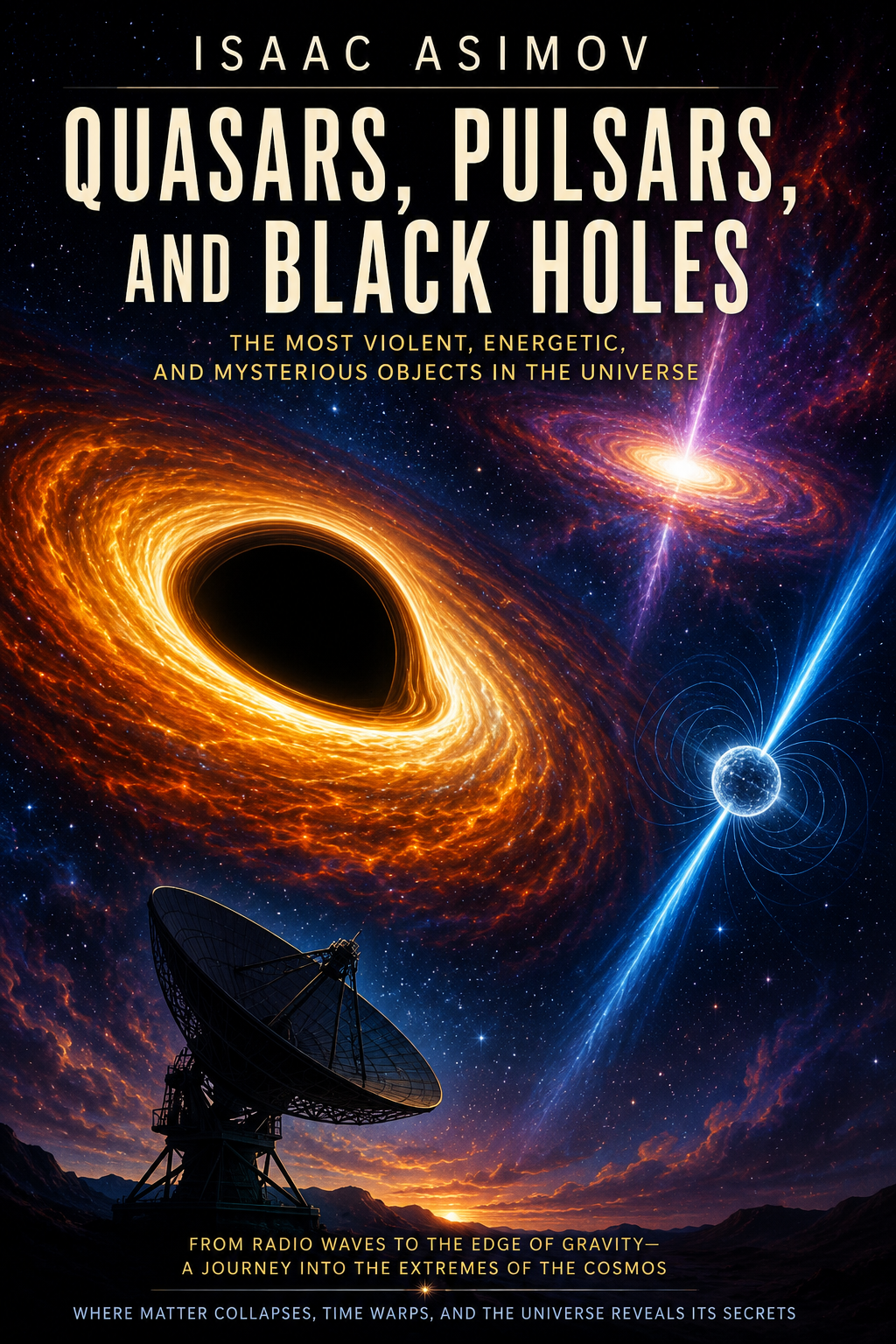
The story of our understanding of the universe is a grand adventure of discovery, and Isaac Asimov's Quasars, Pulsars, and Black Holes captures this journey as a thrilling cosmic detective story. The narrative builds from a simple, historical truth: every time humanity constructs a more powerful instrument to look at the sky, the universe completely surprises us. For hundreds of years, astronomers felt secure in their knowledge of the heavens. They believed they had cataloged the essential elements of the cosmos, from stars and planets to comets, nebulae, and distant galaxies. The night sky appeared orderly, quiet, and deeply familiar. However, this sense of complacency was shattered in the twentieth century when the birth of radio astronomy opened an entirely new, invisible window onto the universe. Suddenly, the cosmos was revealed to be a place of extreme violence, immense energy, and profound mystery.
Asimov presents this adventure not by relying on wild fantasy, but by carefully tracing the steps of real world scientific observation. Nature rarely presents its deepest secrets openly; instead, scientists must piece together microscopic clues, eliminate theories that do not fit, and slowly construct a logical picture of reality. The strange phenomena of quasars, pulsars, and black holes were not dreamt up by theorists working in isolation. They forced their way into human consciousness because physical observations simply refused to align with existing scientific ideas. Each subsequent discovery challenged astronomers, forcing them to rethink the very laws that govern space and time.
The first mini story within this cosmic saga concerns the unexpected birth of radio astronomy itself. During the early decades of the twentieth century, engineers working on long distance radio communication noticed persistent, mysterious static interfering with their signals. Initially, these electrical disturbances were regarded as a mere nuisance rather than a scientific breakthrough. Yet, curious minds eventually realized that these signals were not artificial, nor did they originate on Earth; they were the invisible voices of the heavens. Astronomers came to understand that cosmic bodies emit far more than just visible light. By building giant, dish shaped radio antennas capable of gathering these long, faint radio waves, scientists began to map an entirely invisible universe. This mapping effort revealed a major puzzle: several powerful radio sources, dubbed "radio stars," had no corresponding objects visible in ordinary telescopes. They appeared incredibly small, yet they radiated unimaginable levels of energy, presenting a deep mystery that existing physics could not explain.
The second mini story moves directly into the heart of the 1960s to examine the baffling phenomenon of quasars. One exceptionally bright radio source, labeled 3C 273, finally began to reveal its secrets when astronomers matched its position to a faint, star like dot of light. When they analyzed this light using spectroscopy, they obtained a highly perplexing result: the object's spectral lines were shifted dramatically toward the red end of the spectrum. According to the theory of an expanding universe, such an extreme redshift meant the object was located billions of light years away. This created a staggering paradox: if a point of light so far away could still be seen from Earth, it had to be emitting hundreds or thousands of times more energy than an entire galaxy of hundreds of billions of stars combined. Asimov leads us through the brilliant deduction that these objects are not single stars at all, but quasars, the super brilliant cores of active galaxies. Because nuclear fusion inside stars is far too weak to generate such power, scientists turned to gravity. When vast amounts of gas fall into an extremely compact, massive object, gravitational energy is converted into intense radiation with extraordinary efficiency, heating the matter until it blazes across the spectrum. This elegant solution showed that gravity, which softly pulls an apple to the ground, can become the most powerful energy engine in the universe under the right cosmic conditions.
The third mini story shifts the narrative to the discovery of pulsars, which announced themselves not through massive, steady glare, but through perfect, rhythmic regularity. Radio astronomers scanning the sky noticed faint, pulsing signals repeating with absolute precision, some ticking every second and others many times a second. The timing was so flawless that it surpassed the accuracy of humanity’s best mechanical clocks. In their excitement and bewilderment, the discovering scientists jokingly labeled the signal "Little Green Men," wondering if they had stumbled upon an interstellar transmission from an alien civilization. However, as more pulsars were discovered in completely different regions of space, the extraterrestrial explanation was ruled out in favor of an even more spectacular natural reality: the neutron star. When a massive star burns through its nuclear fuel, it can no longer support itself against its own weight, and gravity crushes it inward. If the star has enough mass, its atoms are compressed until protons and electrons merge into neutrons, creating a neutron star only a few miles wide but containing more mass than our Sun. Due to the conservation of angular momentum, this collapsed star spins at blinding speeds, much like an ice skater pulling in their arms. Possessing a colossal magnetic field, the rotating neutron star shoots beams of radiation from its magnetic poles. As the star spins, these beams sweep across space like a celestial lighthouse; every time a beam crosses Earth, we observe a sharp radio pulse.
The fourth mini story delivers the narrative to the logical extreme of stellar collapse: the black hole. Long before black holes became a staple of popular culture, physicists studying Einstein's General Theory of Relativity realized that gravity could theoretically become so intense that nothing, not even light, could escape its grasp. Asimov explains this profound concept clearly, starting with the everyday idea of escape velocity. To escape Earth's gravity, an object must travel at least seven miles per second. If you compress a massive object into a smaller and smaller radius, its surface gravity intensifies, and its escape velocity rises. Eventually, if the mass is compressed tightly enough, the escape velocity reaches and exceeds the speed of light. At this point, the boundary known as the event horizon is established, and the object becomes completely invisible. Although a black hole cannot be seen directly, Asimov shows that it still betrays its presence through its gravitational influence. Gas falling toward it forms a rapidly spinning accretion disk, rubbing together and heating up until it glows intensely in X rays before crossing the threshold of no return. These invisible monsters can form from the collapse of individual massive stars, or they can exist as supermassive black holes at the centers of galaxies, powering the brilliant quasars described in the earlier chapters.
In reviewing the entire work, one is struck by how masterfully Asimov transforms complex astrophysics into an engaging scientific detective story. He does not rely on dry mathematical formulas; instead, he relies on pristine, step by step logical deduction, vivid analogies, and rich historical context. Each chapter is a stepping stone that builds naturally upon the last, allowing readers to transition seamlessly from simple radio static to the exotic physics of neutron stars and supermassive black holes. By demonstrating how these seemingly isolated cosmic wonders, quasars, pulsars, supernovae, and relativity, are actually deeply connected phases in the life cycles of stars and galaxies, Asimov weaves a unified and coherent narrative of the cosmos. Even though modern astronomy has refined the specific details of these phenomena since the book was written, the central lesson of the narrative remains completely timeless. The universe continues to exceed the limits of human imagination, and every new instrument we construct expands not only our sight, but our profound sense of wonder. Asimov leaves the reader with a deep, abiding confidence that science is an endless, beautiful journey where every mystery we successfully solve only reveals an even larger and more fascinating universe waiting just beyond the horizon.