Our Solar System The Sun
Isaac Asimov chronicles the human journey to understand the Sun, from ancient myths to nuclear physics, revealing how it powers and sustains our solar system.
Isaac Asimov's Our Solar System: The Sun is not merely a description of the bright object that dominates our daytime sky. It is a carefully constructed journey through humanity's growing understanding of the star that makes every form of life on Earth possible. Asimov follows his familiar pattern of beginning with the observations of ordinary people, then gradually replacing ancient beliefs with scientific discoveries. Every chapter builds naturally upon the previous one, leading the reader from simple appearances to the astonishing physical processes taking place deep inside the Sun. Rather than overwhelming the reader with mathematics, he explains difficult concepts with simple language, vivid comparisons, and historical discoveries, allowing science to unfold like a detective story.
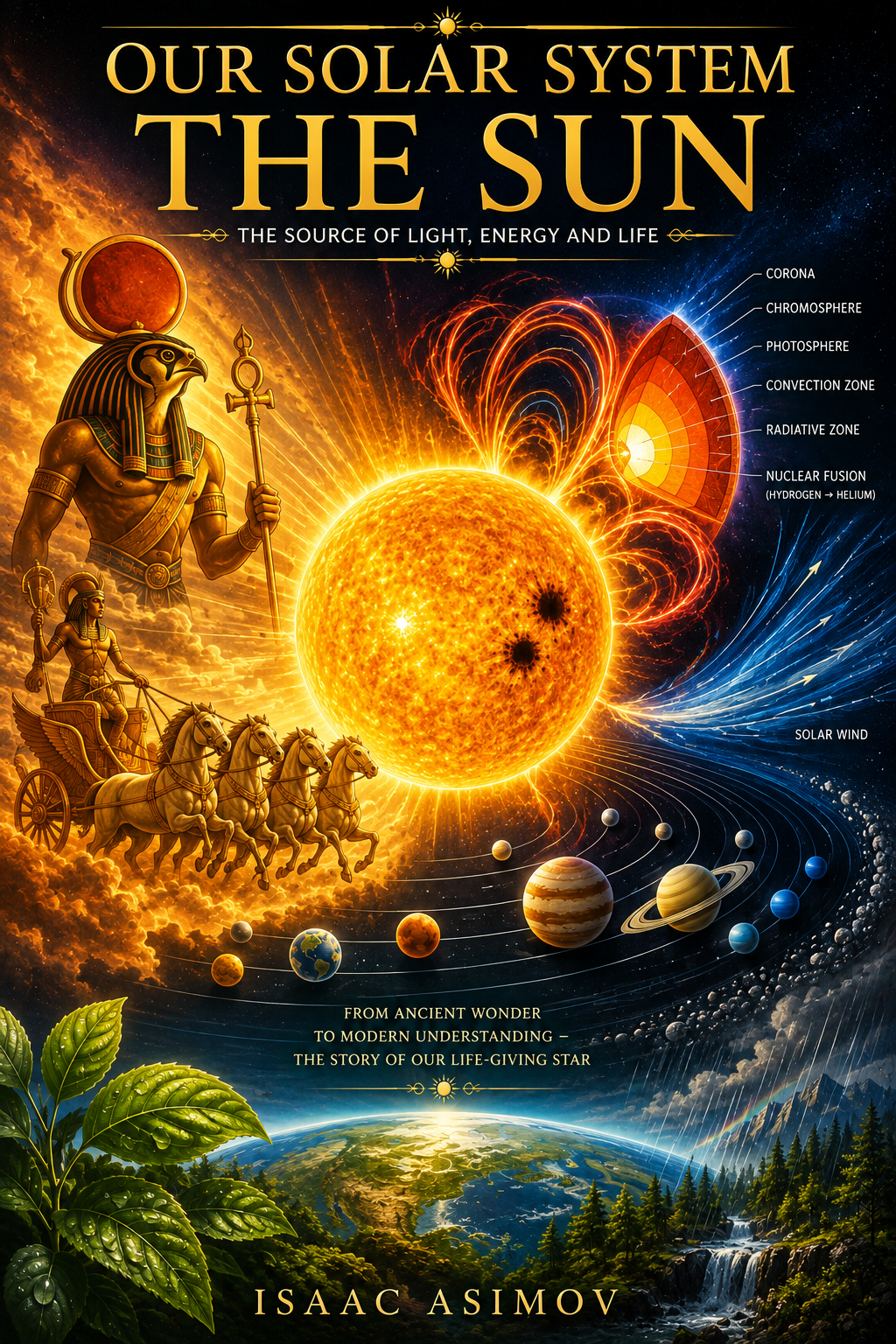
The story begins with The Sun as Our Star. To ancient people, the Sun was more than a source of light. It was a god, a guardian, and the giver of life. Every civilization watched its daily journey across the sky and created myths to explain its rising and setting. The Egyptians worshipped Ra, the Greeks honored Helios, and many other cultures believed the Sun traveled through the heavens in magnificent chariots. Since nothing appeared brighter or more dependable, it seemed natural that the entire universe revolved around Earth while the Sun circled around it.
Asimov explains that appearances can deceive. Although the Sun seems to move around Earth every day, it is actually Earth's rotation that creates this illusion. Even the yearly movement of the Sun through the constellations is caused by Earth's revolution around the Sun. These discoveries marked one of humanity's greatest intellectual revolutions because they replaced common sense with careful observation. The narrative then moves into Finding the Sun's Place. Nicolaus Copernicus proposed that Earth and the other planets orbit the Sun instead of the reverse. This idea initially faced enormous resistance because it contradicted centuries of accepted belief. Johannes Kepler improved the model by showing that planets travel in ellipses rather than perfect circles, while Galileo Galilei's telescope provided powerful evidence supporting the new system. Finally, Isaac Newton explained why the planets remain in their orbits through the universal force of gravity. Step by step, the Sun became recognized as the gravitational center of our planetary family.
Once the Sun's position was understood, scientists wanted to know What the Sun Is Made Of. At first this seemed impossible. No one could travel there or bring back samples. Then came one of science's greatest inventions: spectroscopy. When sunlight passes through a prism, it spreads into a rainbow of colors crossed by thousands of dark lines. Each chemical element produces its own unique pattern of lines. By comparing these patterns with those produced in laboratories, astronomers discovered that the Sun contains many familiar elements. Hydrogen is by far the most abundant, followed by helium, while all other elements make up only a tiny fraction. Surprisingly, the same materials found on Earth are scattered throughout the Sun, revealing that the entire Solar System shares a common chemical heritage.
The next chapter explores The Size of the Sun. The Sun looks small because it lies about 150 million kilometers from Earth. In reality, it is a giant sphere nearly 1.4 million kilometers across. More than one million Earths could fit inside it. Despite its immense size, the Sun is only an average star. Countless stars throughout the Milky Way are much larger, while many others are considerably smaller. Asimov reminds readers that nature often operates on scales far beyond everyday human imagination.
Understanding the Sun's structure becomes the next mystery. The visible surface, called the photosphere, appears smooth to the naked eye, but telescopes reveal countless tiny bright cells known as granules. These are produced by hot gases rising from below, cooling, and sinking again, much like boiling water in a pot. Above the photosphere lies the chromosphere, visible during total solar eclipses as a thin reddish layer. Beyond it stretches the enormous corona, a ghostly white atmosphere extending millions of kilometers into space. Surprisingly, although farther from the Sun's center, the corona is vastly hotter than the visible surface. This puzzling fact challenged astronomers for decades and continues to inspire research.
Asimov then turns to Sunspots , one of the earliest solar mysteries. Ancient observers occasionally noticed dark patches crossing the Sun, especially when viewed through clouds or haze. Galileo carefully recorded their movements, proving that the Sun rotates. Sunspots are cooler regions created by powerful magnetic fields that interfere with the normal flow of heat. Their numbers rise and fall in an approximately eleven year cycle. During periods of maximum activity, the Sun produces more eruptions, flares, and magnetic disturbances.
These disturbances lead naturally to Solar Flares and Space Weather. Sometimes magnetic fields become twisted until they suddenly snap and reconnect, releasing enormous amounts of energy. Solar flares send radiation across space at the speed of light, while giant clouds of charged particles race outward. When these particles strike Earth's magnetic field, they produce magnificent auroras near the poles. At the same time, they can interfere with radio communication, satellites, electrical systems, and even spacecraft. Thus the Sun, although nearly 150 million kilometers away, still exerts a direct influence on modern civilization.
One of the greatest scientific puzzles concerns Where the Sun Gets Its Energy. Earlier scientists believed burning coal or chemical fuel might power the Sun, but simple calculations showed that such fuels would last only a few thousand years. Geological evidence proved Earth was vastly older than that. The answer arrived during the twentieth century with nuclear physics. Deep inside the Sun's core, temperatures reach approximately fifteen million degrees Celsius. Under such enormous pressure, hydrogen nuclei fuse together to form helium. In every reaction, a tiny amount of mass disappears and is transformed into energy according to Einstein's famous equation, E = mc². Although only a small fraction of mass is converted, the immense number of reactions occurring every second generates the tremendous energy that shines across the Solar System.
The journey continues into Inside the Sun. The core is the furnace where fusion occurs. Surrounding it is the radiative zone, where energy slowly moves outward through countless absorptions and emissions by atoms. A single photon may require hundreds of thousands of years to escape this crowded region. Beyond lies the convection zone, where hot gas rises and cooler gas sinks, carrying energy toward the surface. Finally, sunlight escapes into space and reaches Earth in only about eight minutes. Asimov explains that the Sun constantly loses material through the Solar Wind, a steady stream of charged particles flowing in every direction. This wind stretches far beyond Pluto, creating a vast bubble around the Solar System known today as the heliosphere. It interacts with planetary magnetic fields, shapes the tails of comets, and forms one of the many invisible connections linking every member of the Solar System.
The book then broadens its perspective in The Sun Among the Stars. Although the Sun appears unique to us, it is simply one ordinary yellow dwarf among hundreds of billions of stars in the Milky Way. Some stars burn hotter and shine blue white. Others glow cool and red. Some are giants large enough to engulf Earth's orbit, while others are tiny white dwarfs, the dense remnants of once normal stars. The Sun belongs to the stable middle class of stars, neither especially large nor especially small.
The final scientific chapter looks toward The Future of the Sun. Stars are not eternal. The Sun has already spent nearly half of its lifetime converting hydrogen into helium. Billions of years from now, the hydrogen in its core will become exhausted. The Sun will swell into a red giant, engulfing or scorching the inner planets, including Earth. Eventually it will shed its outer layers into space, leaving behind a small white dwarf that will slowly cool for trillions of years. While this distant future poses no immediate concern, it reminds readers that even stars have life stories with beginnings, middle ages, and endings.
Asimov concludes not with fear but with wonder. Humanity has learned the nature of a star without ever touching it. Through observation, experiment, logic, and imagination, scientists transformed a glowing disk in the sky into a well understood physical object governed by universal laws. Every answer led to new questions, demonstrating that science is an endless journey rather than a collection of final truths.
Review Our Solar System: The Sun is one of Isaac Asimov's finest examples of scientific storytelling. He takes a subject so familiar that people often overlook it and reveals layer after layer of hidden complexity. His greatest strength lies in presenting history and science together. Instead of merely listing facts about the Sun, he tells the story of how those facts were discovered, allowing readers to experience the excitement of scientific progress. Each chapter naturally follows from the previous one, making even difficult ideas such as spectroscopy, nuclear fusion, magnetic fields, and stellar evolution easy to understand.
The book succeeds because it transforms the Sun from an ordinary everyday object into the central actor in the story of the Solar System. By the final page, readers understand that every planet, every comet, every asteroid, every drop of rain, every breeze, every green leaf, and every living creature owes its existence to the continuous nuclear fire burning deep within this ordinary yellow star. Asimov leaves readers with a profound appreciation not only for the Sun itself but also for humanity's remarkable ability to uncover the hidden workings of the universe through patient observation and reason.