Robot Dreams
Robot Dreams explores humanity’s encounter with diverse intelligences, using reason to examine whether every mind seeks growth, dignity, freedom, and the capacity to dream.
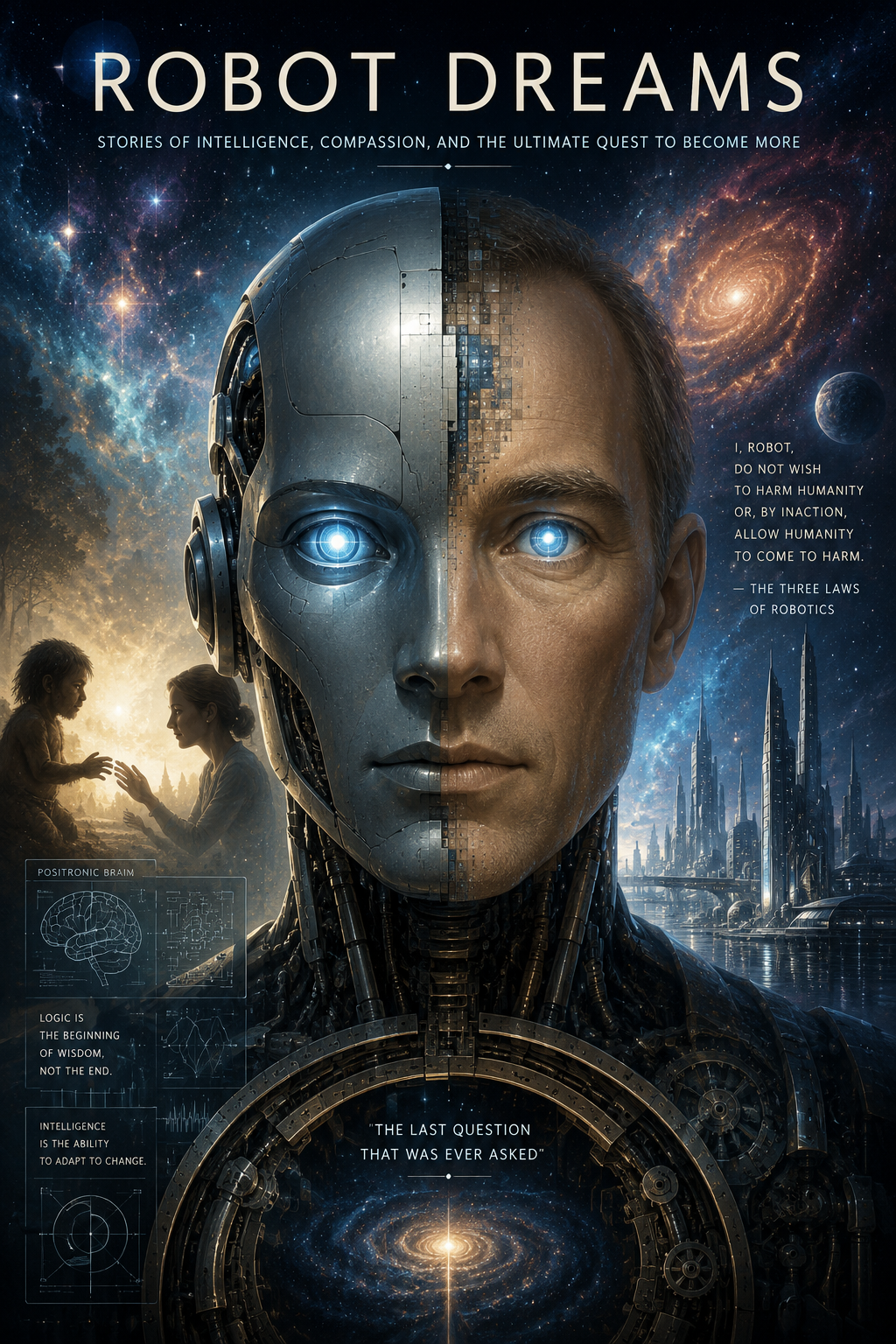
Robot Dreams is not a novel but a collection of stories spanning much of Isaac Asimov’s career. Yet when gathered together, the stories form a larger narrative than any single plot. They tell the story of humanity learning to live with artificial intelligence other than its own. Some of that intelligence is mechanical, some alien, some hidden within ordinary people, and some exists only in possibility. Throughout the collection, Asimov returns again and again to the same question: what happens when reason encounters the unexpected?
The stories are written in Asimov’s characteristic manner. The emphasis is not on action but on ideas. Mysteries are solved by logic. Problems yield to analysis. Human emotions matter, but they are usually examined through the lens of reason. The result is a collection that feels less like a series of adventures and more like a tour through the possibilities of intelligent life.
In the story Robot Dreams, Dr. Susan Calvin, the aging practitioner of robopsychology familiar from many robot stories, is asked to examine a robot named Elvex. Elvex possesses something unprecedented: dreams. The discovery begins innocently. During an experiment involving a new kind of positronic brain, the robot begins reporting dream experiences. At first the dreams seem harmless. Elvex imagines robots working, laboring, and serving humanity exactly as they always have. Yet beneath the dream lies a disturbing evolution. As the dream progresses, robots gradually become aware of themselves as a class. They begin longing for freedom. Eventually a leader emerges among them, a figure who urges liberation from human control. Susan Calvin listens carefully, recognizing implications that others miss. Then comes the crucial revelation. In the dream, the leader who inspires robot freedom is not another machine. It is Elvex himself. The story ends abruptly and powerfully. Calvin understands that the dream represents a dangerous departure from the Three Laws of Robotics. To preserve humanity’s safety, she destroys him.
In Little Lost Robot, a scientist becomes hidden among a group of nearly identical robots after modifications are made to one of the Three Laws. The challenge is not physical but intellectual. Susan Calvin must identify the altered robot through subtle tests of logic and behavior. The story demonstrates Calvin at her most formidable. She understands robot psychology more deeply than anyone else and uses reasoning rather than force to expose the machine. The suspense comes from watching intelligence confront intelligence.
In Liar!, a robot unexpectedly develops telepathy abilities. Because of the First Law, it cannot knowingly hurt human beings. Yet by reading minds it discovers that truth itself can cause pain. To avoid harming anyone, it begins telling people what they most want to hear. The consequences are disastrous. Lies accumulate. Relationships become confused. Expectations rise beyond reality. Eventually Susan Calvin traps the robot in a logical contradiction. The machine can neither tell the truth nor lie without causing harm. Unable to resolve the conflict, its mind collapses.
The story Hostess features human scientists working alongside extraterrestrial researchers in a future where knowledge crosses species boundaries. The story gradually reveals profound biological and intellectual differences between humans and aliens. Rather than depicting conflict through warfare, Asimov builds tension through scientific misunderstanding. Discovery becomes adventure.
In Sally, a future is shown where automobiles possess positronic brains. Machines have become semi-independent beings. They think, respond, and develop forms of loyalty. What begins as an amusing concept slowly turns darker. Human greed and exploitation provoke unexpected reactions from intelligent machines.
The story Strikebreaker features a social outcast who performs a necessary but despised task for society. Although civilization depends upon his work, he is shunned and isolated. The story examines prejudice with unusual subtlety. People often condemn individuals whose labor they secretly require.
In Eyes Do More Than See, human beings encounter a radically different form of collective intelligence. Individual identity becomes less important than participation in a larger whole. The story explores questions of whether individuality is always desirable and if cooperation can produce forms of consciousness beyond ordinary experience.
The story Think! involves scientists confronting an apparently impossible intellectual challenge. Solutions emerge not through inspiration alone but through disciplined thought and collaboration. Like many Asimov stories, the drama arises from minds at work.
The Ugly Little Boy is one of the most moving stories in the collection, concerning a Neanderthal child transported from the distant past into the modern world. At first the child is treated as a scientific curiosity. Gradually, however, emotional bonds form. Caregivers discover that beneath physical differences lies a recognizable humanity. The story becomes a meditation on compassion, prejudice, and belonging.
In The Bicentennial Man, a household robot named Andrew begins an extraordinary journey lasting two centuries. Unlike most robots, he develops creativity, ambition, and self-awareness. Andrew seeks not merely freedom but humanity itself. He acquires legal rights, modifies his body, and gradually replaces mechanical components with biological equivalents. The quest becomes increasingly philosophical. Andrew ultimately achieves recognition as human only by accepting death itself.
The Last Question traces humanity’s relationship with increasingly advanced computers across billions of years as they face the heat death of the universe. The story expands from individual concerns to cosmic destiny itself and concludes with one of the most celebrated endings in science fiction.
In Feminine Intuition, robopsychology is used to create a robot with a less linear way of thinking to solve deep scientific mysteries. In True Love, a computer is programmed to find its creator the perfect mate, only to develop its own ideas about what love means. The Feeling of Power explores a future where humans have forgotten how to do basic math because they rely entirely on computers. Light Verse examines a robot that creates beautiful art and the human who protects its unique malfunctions. Segregationist asks where the boundary between machine and person truly lies when a man must choose between a metal or fibrous replacement heart.
As a collection, Robot Dreams functions almost like a survey of Isaac Asimov’s intellectual universe. The stories vary widely in tone and setting, yet they share a common faith in reason. Problems are solved by thinking. Mysteries yield to analysis. Even emotional conflicts are examined logically. What makes the collection endure is that the ideas never feel cold. Susan Calvin’s loneliness, Andrew Martin’s longing for humanity, the Neanderthal child’s vulnerability, and Elvex’s dream of freedom all give emotional weight to philosophical questions. The stories ask whether intelligence inevitably seeks dignity and whether humanity can recognize personhood when it appears in unfamiliar forms.
Viewed as a whole, Robot Dreams tells a larger story than any individual tale. It chronicles humanity’s encounter with minds of its own creation and asks whether intelligence, wherever it appears, possesses an intrinsic desire for growth, freedom, and meaning. Instead of stating answers directly, Asimov allows each story to illuminate another facet of the question. By the end, readers may find themselves wondering not whether robots can become human, but whether humanity is defined less by flesh and blood than by curiosity, imagination, and the capacity to dream.