The Best Mysteries of Isaac Asimov
These thirty one stories celebrate logic, proving clear thinking and observation solve every mystery because the universe is understandable through the patient application of human intelligence.
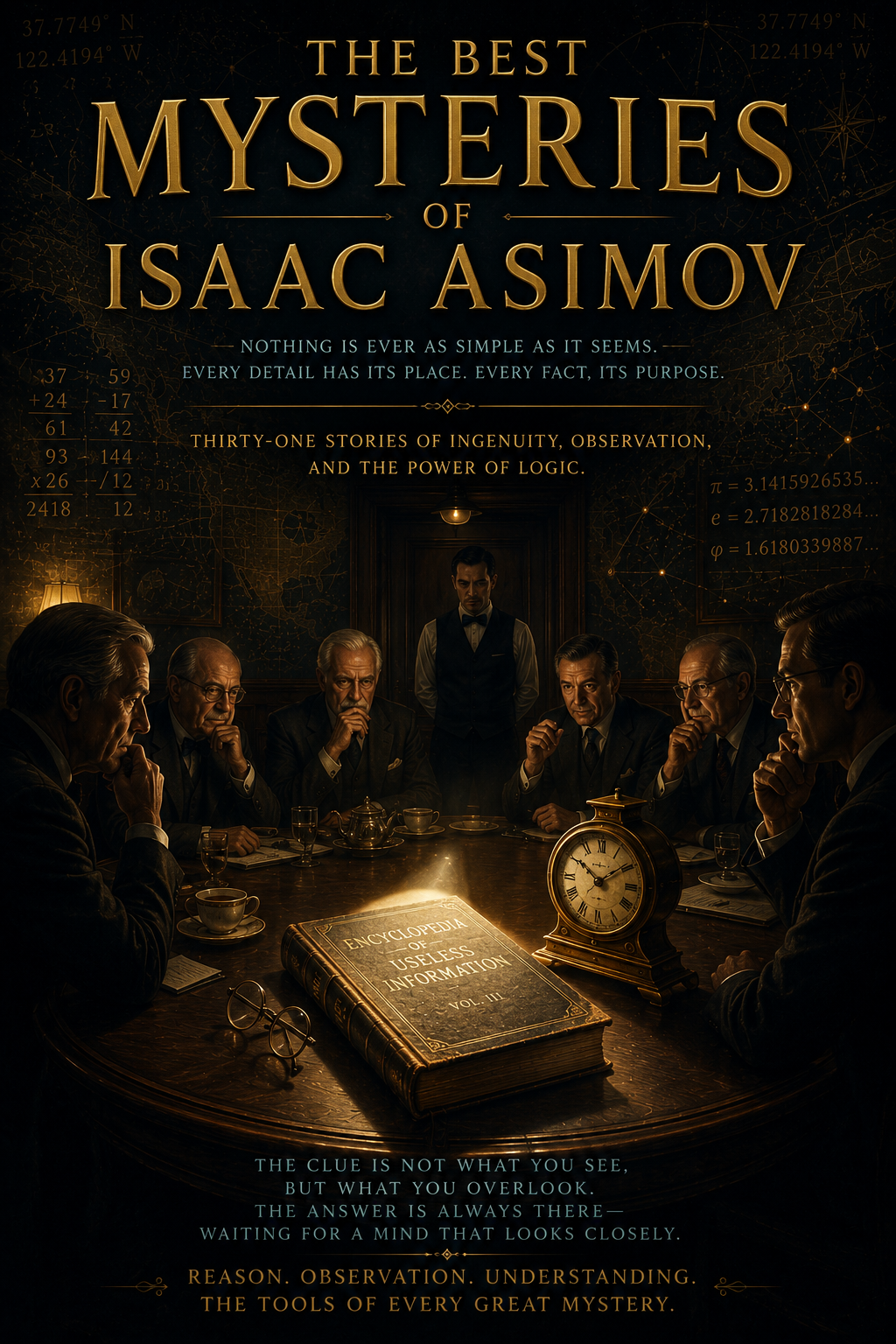
Imagine a reader who has spent years traveling through the reaches of the Galactic Empire or watching the positronic brains of robots grapple with the Three Laws. This reader might expect a book of mysteries by the same author to be filled with high tech gadgets or alien conspiracies. However, as one opens The Best Mysteries of Isaac Asimov, they find themselves in a surprisingly grounded world. This 1986 collection of thirty one stories reveals that the mind responsible for the Foundation saga is just as comfortable in a quiet library or at a dinner table as it is in deep space. Asimov demonstrates here that the greatest tool for any investigator is not a blaster or a spaceship, but the simple, clear application of logic.
The collection feels like a long inviting conversation with a master puzzle maker who believes that the universe, no matter how confusing it seems, is ultimately understandable. Instead of relying on the typical tropes of mystery fiction, such as physical danger or high speed chases, Asimov focuses on observation and the architecture of logic. Every story begins with a small inconsistency a fact that does not fit or a statement that sounds slightly off and proceeds to untangle the knot through patient reasoning. In many ways, these stories are the spiritual siblings of his robot mysteries; just as a robot’s behavior is governed by logical laws, the human puzzles in this book are governed by patterns that can be decoded by a sharp mind.
The first major section of the book introduces us to the Black Widowers, a group of intelligent men who meet regularly for dinner and conversation. At each gathering, a guest presents a problem, and while the members of the club offer complex and often vain theories, it is Henry, the humble waiter, who invariably finds the solution through practical wisdom. Following these are the Union Club stories, which are framed as warmer, more anecdotal exchanges among friends. Finally, the book concludes with a variety of stand alone mysteries and tales featuring Larry, a young detective who proves that rational thinking is a skill available to everyone, regardless of age. Throughout every section, the true hero of the book is logic itself, affirming that truth can always emerge from careful thought.
In the first of the Black Widowers tales, The Obvious Factor, the narrative explores how human assumptions can act as a veil, hiding the truth by leading people to ignore what is right in front of them. The Pointing Finger continues this theme by examining how a single gesture or a silent movement can communicate far more information than a spoken confession. In Out of Sight, the puzzle shifts focus to what is missing rather than what is present, forcing the reader to consider the significance of an empty space. Yankee Doodle Went to Town takes a different approach by using historical facts and the nuances of language to build a bridge toward a logical conclusion.
The mystery titled Quicker Than the Eye challenges the reliability of human perception, suggesting that what we think we see is often influenced by our refusal to question the obvious. The Three Numbers presents a classic numerical puzzle where seemingly meaningless digits contain a hidden pattern that provides the answer. In The One and Only East, Asimov plays with the reader's assumptions regarding geography and direction, showing how easily we can be misled by the words we use every day. The Cross of Lorraine uses the historical and symbolic context of an object to reveal its true significance, while The Next Day focuses on the vital importance of chronology and the sequence of events.
The concept of time remains central in What Time Is It?, where the mechanics of timekeeping provide the key to solving an apparently impossible situation. The collection then moves through a series of stories including Middle Name, Sixty Million Trillion Combinations, The Good Samaritan, Can You Prove It?, and The Redhead, all of which reinforce the idea that ordinary details like names or physical descriptions can hide extraordinary meaning when viewed through a logical lens. Asimov’s writing in these pieces is clear and inevitable; once the solution is presented, it feels as though it could not have been any other way.
Transitioning into the Union Club mysteries, He Wasn’t There again utilizes the concept of absence to solve a problem, showing that a missing person can be the loudest evidence of all. Hide and Seek turns a common game into a study of expectation, teaching the detective that the secret to finding something is to look at the world differently. Financial details take center stage in Dollars and Cents, where Asimov transforms the supposedly dull world of money into a source of vital clues. The Sign focuses on how a specific mark or message can only be understood when its symbolic meaning is correctly interpreted.
In Getting the Combination, the story moves away from mechanical security to explore how human psychology is often the weakest link in any lock. The Library Book highlights Asimov's love for research and learning, showing how pure knowledge can serve as the most decisive piece of evidence. The Union Club sequence concludes with Never Out of Sight, The Magic Umbrella, and The Speck, each of which demonstrates how a commonplace or tiny object can become a pivot point for a grander mystery when the observer is attentive enough.
The final section of the book offers a look at Asimov's more diverse mystery writing, starting with The Key, which introduces the young detective Larry and emphasizes that common sense is a powerful form of brilliance. A Problem of Numbers returns to the author's love of mathematics, using numerical patterns to reveal the truth behind a puzzle. The Little Things serves as a summary of Asimov’s entire philosophy, illustrating that the most significant outcomes are often determined by the tiniest details. Halloween provides a slightly more atmospheric setting, yet it still concludes with logic triumphing over the superstition.
As the book nears its end, The Thirteenth Day of Christmas combines the charm of the holidays with a clever deductive puzzle involving tradition and logic. The Key Word explores the intricacies of language, demonstrating how a single word can reveal the identity or intentions of a person. Finally, the collection closes with Nothing Might Happen, a story that perfectly encapsulates the idea that excitement and fascination do not require grand events, but can be found in the careful examination of ordinary life. Together, these thirty one stories serve as a testament to Asimov’s conviction that intelligence, when applied with patience, can illuminate any corner of human experience.