The Best Science Fiction of Isaac Asimov
This anthology collects twenty-eight stories exploring the human mind's logical capacity to solve problems, showing how humanity's vast intelligence confronts the infinite through great curiosity.
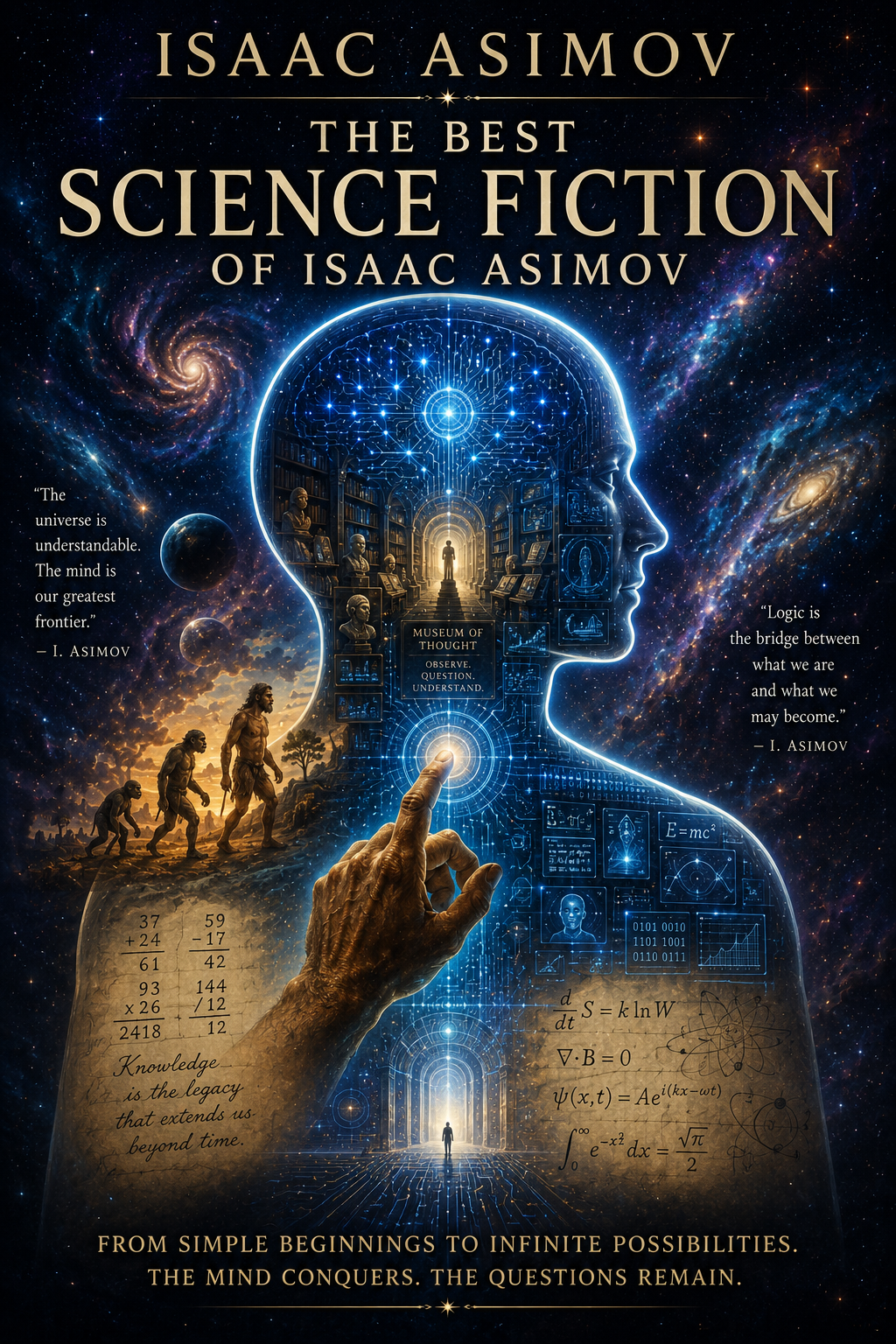
Imagine a reader stepping into a grand gallery of the human spirit, where the exhibits are not made of stone or metal, but of pure thought. This is the experience of opening the 1986 collection titled The Best Science Fiction of Isaac Asimov, a volume that serves as a carefully curated self-portrait of its author. For nearly half a century, the man known as the Great Explainer had been weaving tales that sought to define the relationship between intelligence and the universe. In this anthology, he gathered twenty-eight stories that he felt best represented the intellectual puzzles and themes that defined his career.
Walking through this collection is like engaging in a long, insightful conversation with a friend who is as brilliant as he is clear. Asimov does not rely on the strange monsters or flashy battles often associated with his genre; instead, he focuses on the human mind. He repeatedly asks what happens when a mind encounters a problem that seems larger than itself. Sometimes the result brings laughter, and sometimes it brings a quiet, logical tragedy, but the path to the conclusion is always paved with reason. He believed that the universe is ultimately understandable and that our greatest tool is not a weapon, but our capacity to think.
The journey into this mental landscape begins with The Dead Past, where the focus is on the inherent danger of seeking total knowledge. In a world where technology can view any moment in history, what initially appears to be a gift to scholars and historians begins to look like a threat to the very idea of privacy. The story builds from a simple scientific desire and leads toward a realization that every new discovery changes society in ways that are impossible to fully predict. It suggests that once knowledge is unleashed, it cannot be contained, and the world it creates may be one we are not prepared to live in.
In Franchise, the narrative shifts to the logic of democracy and the power of Political Science. Asimov looks toward a future where the complexities of voting are simplified by a massive computer that selects a single representative individual to determine an entire election. The story explores the heavy burden placed on one ordinary person and questions whether a statistical model can ever truly replace the collective voice of a nation. It is a study of how individuals relate to the massive systems they inhabit.
The mood changes with The Fun They Had, a gentle look at the evolution of education. It focuses on the curiosity of children in a computerized future who find an old book and wonder about a time when students actually learned together in a physical building. The story builds from a simple discovery and leads to a profound sense of nostalgia, suggesting that while technology can make learning more efficient, it might also strip away the human interaction that makes life meaningful.
A more complex exploration of the mind appears in Dreaming Is a Private Thing, where the act of dreaming is transformed into a commercial art form. The narrative follows a professional who creates these dreams for public consumption, leading to a tension between personal creativity and the demands of the marketplace. This fascination with the power of imagination continues in Dreamworld, where the boundaries between what we desire and what is real begin to blur. In both tales, Asimov remains grounded in logic, showing that even the most fantastic dreams must follow their own internal rules.
One of the collection’s most striking warnings in the collection is The Feeling of Power, which examines a society that has become entirely dependent on Computer technology. When a man rediscovers the ability to perform basic Arithmetic by hand, the discovery is treated with shock and awe. The story builds from this small rediscovery of a lost skill and leads to a dark realization about how technology can make humanity vulnerable by causing us to surrender our own fundamental capabilities. It highlights how knowledge can be repurposed for goals that the original inventor never intended.
Humor is a thread that runs through many of the corridors of this anthology. In I’m in Marsport Without Hilda, we see a traveler whose futuristic journey is derailed by the same kind of mundane misunderstandings and inconveniences that plague us today. It serves as a reminder that no matter how much technology changes, human absurdity remains constant. Similarly, A Loint of Paw uses linguistic puzzles and strange interactions between the ordinary and the supernatural to show that logic can be applied even to the most whimsical situations.
Asimov also turns his logical eye upon his own profession in The Foundation of S.F. Success, a story that gently mocks the idea that creativity can be reduced to a mechanical formula. This self-parody stands in contrast to the psychological chill of Flies, where scientific experiments lead not to physical monsters, but to a terrifying change in the human psyche. In these stories, the author demonstrates that horror and humor both arise from the logical implications of a single idea.
The collection delves into the darker side of social structures in Strikebreaker, which looks at a future society built on rigid segregation and the guilt that comes with it. It explores how people can convince themselves they are enlightened while still maintaining invisible classes of outcasts. This is balanced by the emotional depth of The Ugly Little Boy, which brings a child from the Paleontology records into the present. What starts as a cold scientific experiment leads to a deeply moving relationship that asks us to define what truly makes us human: is it our intelligence, or is it our capacity for compassion?
The theme of the gap between generations is explored in My Son, the Physicist, where a father tries to connect with a son whose knowledge has surpassed his own understanding. It is a story that builds from a scientific discussion but leads to a universal truth about parental love. Intellectual comedy returns in The Immortal Bard, as William Shakespeare is brought to the modern world via time travel. Rather than being a source of deep literary insight, the playwright is shown to be a practical man who is baffled by the academic interpretations of his work, offering a sharp satire of modern criticism.
The anthology reaches its philosophical peak with two companion pieces, The Last Answer and The Last Question. The former looks inward at the nature of consciousness and death, while the latter expands outward across billions of years of cosmic history. The Last Question follows humanity and its ever improving computers as they struggle with the ultimate problem of Entropy and the end of the universe. It builds through various eras of history, each one searching for a way to reverse the decline of energy, and leads to a final resolution that achieves a sense of cosmic grandeur. Asimov considered this to be one of his finest works because it is a story about the very nature of existence.
Other stories in the collection continue to follow the same logical path. Jokester investigates the hidden origins of why we find things funny. Obituary imagines a writer capable of predicting futures through fictional biographies. Sure Thing applies statistics to the unpredictability of romance, while Spell My Name with an S uses a story of extraterrestrial contact to deliver a satirical message. Finally, Unto the Fourth Generation explores the connections of ancestry and identity.
In the end, The Best Science Fiction of Isaac Asimov shows that the author’s greatest strength was his clarity. He did not just predict the future; he treated ideas as grand adventures. He used logic to create suspense and reason to inspire wonder. The anthology proves that every story he wrote was part of one larger narrative: the story of the human mind confronting the infinite. Through these pages, we see that problems can be solved through thought and that our curiosity is the most powerful force in the universe.