Tin Stars
Asimov’s Tin Stars anthology features fifteen stories exploring future justice, tracing law’s evolution from Western sheriffs to robotic systems while balancing order, logic, and compassion.
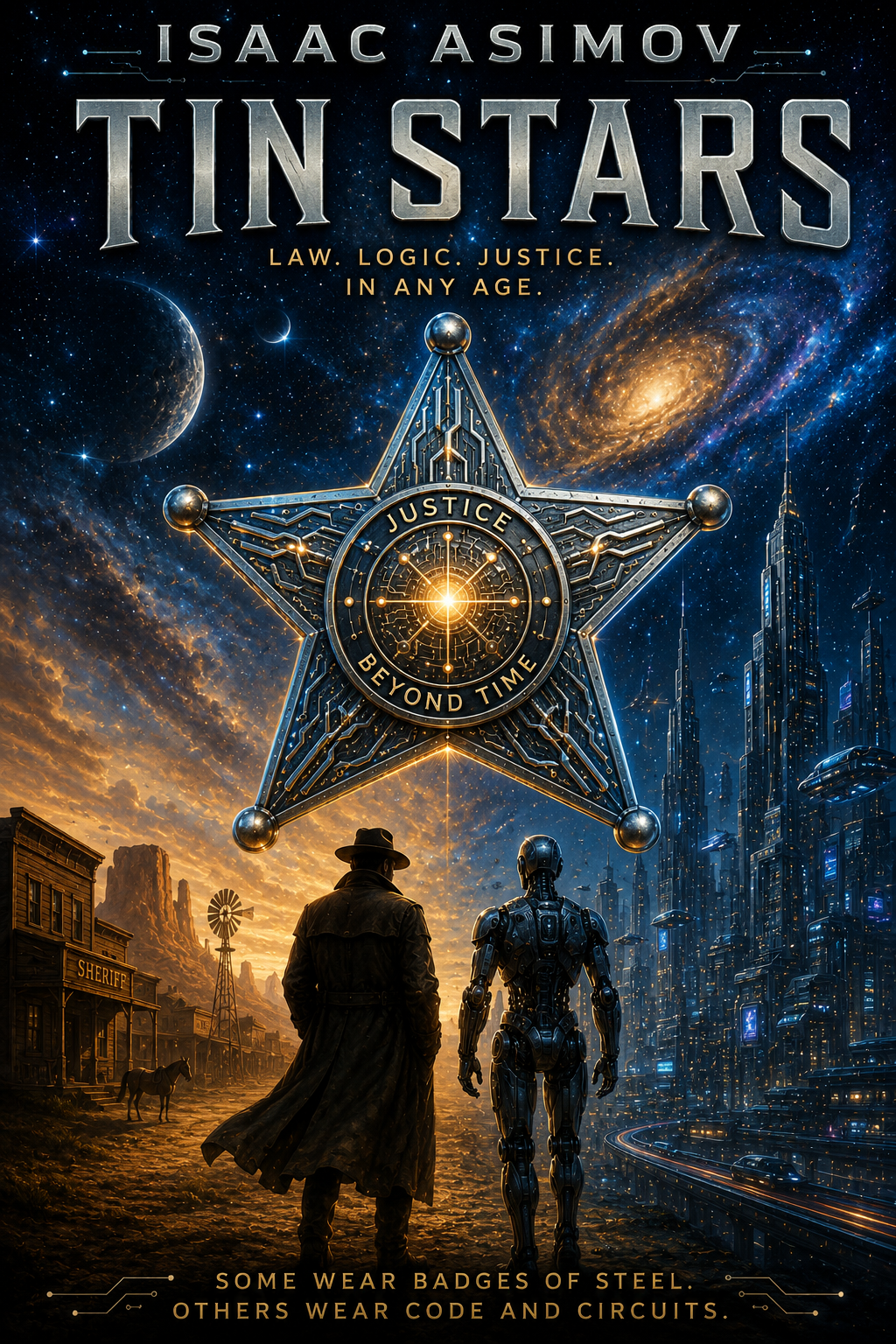
Imagine a time when the dusty trails of the Old West have been replaced by the cold, silent vacuum of space and the gleaming corridors of megacities. In this future, the lawman still exists, but he no longer carries a simple piece of molded lead. The badge he wears, the tin star, has evolved. It might now be made of silicon, steel, or even complex circuits based on Artificial Intelligence. This transformation is the central heart of the anthology titled Tin Stars, a collection edited by Isaac Asimov along with Martin H. Greenberg and Charles G. Waugh. Asimov himself sets the stage by explaining that the traditional sheriff is the symbolic ancestor of every future guardian of order we encounter in these pages. The book is not merely a collection of tales: it is a logical progression through the evolution of law itself, asking if justice becomes easier or more difficult as our tools become more advanced.
Our journey through this future of justice begins with a look at how we might utilize Automation for the long arm of the law. In the story Into the Shop, we see a world where law enforcement is highly mechanical, yet mechanical efficiency repeatedly collides with human unpredictability. It is a reminder that while technology changes our methods, it rarely manages to change our fundamental nature, and bureaucracy remains as thick as ever. This theme of technology's limits is pushed to a darker extreme in Cloak of Anarchy. Here, a society has achieved what looks like perfect peace through an invisible field that makes violence impossible. It is an orderly paradise until a single device is introduced that can bypass these safeguards, revealing just how fragile a civilization becomes when it relies entirely on technological protection instead of personal responsibility.
As we move deeper into the structures of future societies, we find that order is often maintained by systems much larger than any one individual. The King's Legions examines how military discipline and organizational power allow a civilization to function even amidst chaos. It suggests that the survival of order depends on the willingness of people to obey these vast systems. Yet, these systems are not always as grand as they appear. Finger of Fate offers a more ironic perspective, showing us how often what we think is a grand design or a destined path is actually just the result of a simple misunderstanding or a series of human errors. It is a classic exercise in twisting expectations to show the humor behind the curtain of authority.
The mechanical side of justice returns with a sharper edge in Arm of the Law. We are presented with an enforcement mechanism that is perfectly efficient, yet efficiency itself becomes dangerous when a perfectly logical system produces unreasonable outcomes when confronted with messy human realities. It poses the vital question of whether justice can ever truly exist without the flexibility that machines cannot easily provide. In a similar vein, Voiceover takes the familiar traditions of a detective mystery and places them within a strange, speculative future. It shows us that even when the tools change, the intellectual pleasure of solving a puzzle remains a constant human drive.
The influence of our past myths continues to shape the future in The Fastest Draw. The legendary image of the gunfighter is updated for a technological age, where reaction time and skill are pitted against mechanical speed. It asks us to consider if human excellence still holds any value when we create machines that can outperform us in every measurable way. This leads us directly to the intellectual center of the anthology, Isaac Asimov's Mirror Image. This story is a significant entry in the broader history of science fiction because it is the only short story to feature the famous duo of Detective Elijah Baley and his partner R. Daneel Olivaw, a being representing the peak of Robotics. The conflict arises from a paradox where two highly intelligent robots give conflicting testimony, yet their programming prevents them from knowingly lying.
In Mirror Image, there are no dramatic chases or displays of force. Instead, the entire investigation is a masterpiece of abstract reasoning and logic. Baley must navigate the Psychology of the robots and the constraints of the Three Laws of Robotics to find the truth. It is a story that exemplifies the Asimovian tradition where the intellectual journey toward a solution is more important than the crime itself. This focus on the mind continues in Brillo, which explores how our assumptions and first impressions shape our judgment of others. It challenges the reader to look past appearances to find the true identity of an individual.
The human element remains the most vital tool in any investigation, as seen in The Powers of Observation. While machines can process data at incredible speeds, the story reminds us that genuine insight comes from the ancient human skill of noticing patterns that others overlook. Justice is also a matter of the heart, as Faithfully Yours demonstrates. Here, loyalty and trust are examined within the context of technological systems, showing that justice is not just a legal concept but a personal commitment. This balance between the personal and the systemic is further explored in Safe Harbor, which looks at the quiet anxiety of a society trying to find a refuge from danger, often through pervasive Surveillance. It highlights the eternal tension between our desire for perfect safety and our need for individual freedom.
The anthology takes a chilling turn with Examination Day, a story that shows the horrifying logical conclusion of a society that values efficiency above everything else. It begins with a simple intelligence test for children, but as the underlying system is revealed, the reader sees how easily good intentions can transform into a cold and rational form of oppression. This irony is mirrored in The Cruel Equations, where the very principles of logic and bureaucracy we use to organize our lives become instruments of absurdity. It is a satirical look at how reality often refuses to be neatly categorized by human mathematics.
Finally, the collection concludes with Animal Lover, a story that broadens the scope to include compassion and empathy. It asks if an advanced civilization can remain kind while it continues to pursue progress. It serves as a thoughtful ending, suggesting that the ultimate goal of law and justice is not just the management of behavior, but the preservation of our humanity. When we look at Tin Stars as a whole, it functions as a profound conversation about the future of responsibility and morality. The stories reflect many of the concerns we face today, recognizing that while the badge may change from tin to silicon, the challenge of balancing logic with compassion and freedom with order remains the same. It is a testament to the idea that the search for justice is an endless human journey in an increasingly complex universe.